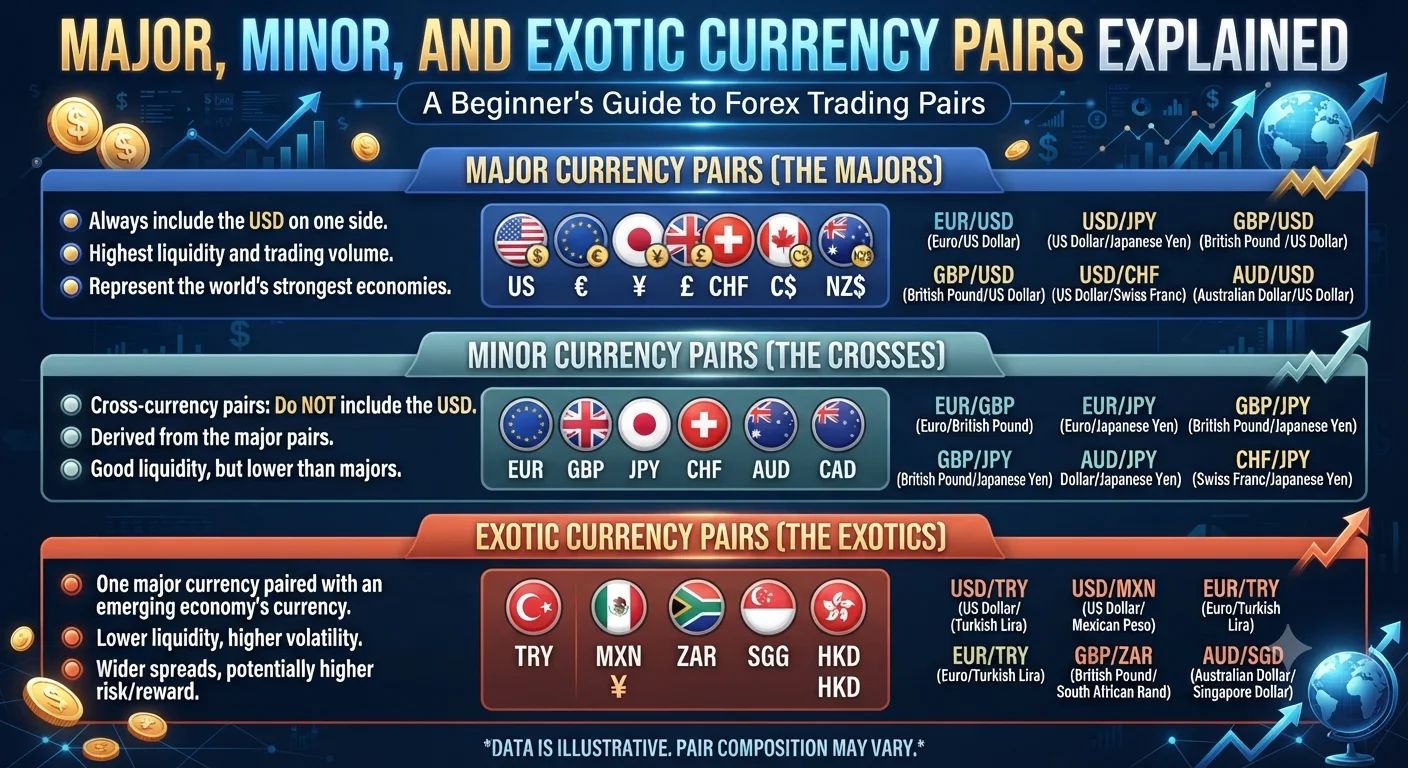
Forex currency pairs are divided into three groups based on how widely they are traded and how much liquidity they carry. Major pairs include the US Dollar and are the most liquid and lowest-cost pairs in the market. Minor pairs exclude the US Dollar but involve other major world currencies. Exotic pairs combine a major currency with a currency from a smaller or emerging economy and carry significantly higher spreads and lower liquidity.
Why Currency Pair Categories Matter
The category a currency pair falls into has direct consequences for your trading costs, execution quality and strategy selection. Trading an exotic pair with the same approach you use on EUR/USD will produce very different results because the spread costs and volatility profile are completely different.
Understanding these three categories helps you make an informed choice about which pairs suit your trading style, account size and risk tolerance.
The Full Breakdown
- Why Currency Pair Categories Matter
- The Full Breakdown
- Major Currency Pairs
- Minor Currency Pairs (Cross Pairs)
- Exotic Currency Pairs
- Choosing the Right Currency Pairs for Your Strategy
- Common Mistakes to Avoid
- Frequently Asked Questions
- Q: What is the most popular currency pair in forex?
- Q: What is the difference between a major and a minor currency pair?
- Q: Why are exotic pair spreads so much wider than major pair spreads?
- Q: Should a beginner trade exotic currency pairs?
- Q: What is a commodity currency in forex?
Major Currency Pairs
Major pairs are defined by two characteristics: they all include the US Dollar on one side and they are the most traded pairs in the world. The US Dollar is the world's primary reserve currency and is involved in approximately 88% of all global daily forex transactions according to the Bank for International Settlements.
Because of this enormous volume major pairs have:
- The tightest spreads of any forex instruments
- The highest liquidity meaning orders fill quickly and accurately
- The most available market analysis, news coverage and commentary
- The most predictable behaviour around well-known technical levels
The seven major currency pairs:
| Pair | Name | Base Currency | Quote Currency |
|---|---|---|---|
| EUR/USD | Euro Dollar | Euro | US Dollar |
| GBP/USD | Cable | British Pound | US Dollar |
| USD/JPY | Dollar Yen | US Dollar | Japanese Yen |
| USD/CHF | Swissie | US Dollar | Swiss Franc |
| USD/CAD | Loonie | US Dollar | Canadian Dollar |
| AUD/USD | Aussie | Australian Dollar | US Dollar |
| NZD/USD | Kiwi | New Zealand Dollar | US Dollar |
EUR/USD is consistently the most traded currency pair in the world, accounting for approximately 22% of daily global forex volume. For most beginner traders EUR/USD is the logical starting point because it has the tightest spreads, the most educational resources available and the most predictable technical behaviour.
Minor Currency Pairs (Cross Pairs)
Minor pairs, also called cross pairs or simply crosses, do not include the US Dollar. They pair two of the other major world currencies against each other directly.
- How Does the Forex Market Work? Currency Pairs, Pips, and Spreads Explained
- What Is Forex Trading? A Complete Beginners Guide
Because the US Dollar is not involved minor pairs generally have:
- Slightly wider spreads than major pairs
- Lower liquidity than majors though still meaningfully liquid during active sessions
- Different volatility characteristics driven by the specific economic relationship between the two countries involved
Common minor pairs:
| Pair | Name | Currencies Involved |
|---|---|---|
| EUR/GBP | Euro Sterling | Euro vs British Pound |
| EUR/JPY | Euro Yen | Euro vs Japanese Yen |
| GBP/JPY | Pound Yen | British Pound vs Japanese Yen |
| EUR/AUD | Euro Aussie | Euro vs Australian Dollar |
| EUR/CAD | Euro Loonie | Euro vs Canadian Dollar |
| GBP/AUD | Pound Aussie | British Pound vs Australian Dollar |
| AUD/JPY | Aussie Yen | Australian Dollar vs Japanese Yen |
GBP/JPY deserves special mention. It is one of the most volatile of all commonly traded pairs with average daily ranges that can exceed 150 pips during active sessions. This makes it attractive to traders looking for large intraday moves but the wider spread and higher volatility mean that risk management must be calibrated accordingly.
EUR/GBP sits at the opposite end of the spectrum. It is one of the least volatile commonly traded pairs because the Eurozone and the UK economies are closely linked. It tends to move slowly and within a narrower range which suits certain range trading and mean-reversion strategies.
Exotic Currency Pairs
Exotic pairs combine a major currency, almost always the US Dollar or the Euro, with the currency of an emerging market or smaller economy. These pairs carry the highest risk and the highest trading costs of all three categories.
Characteristics of exotic pairs:
Recommended Articles
 FOREX TRADING BASICS
 FOREX TRADING BASICS
- Very wide spreads often 10 to 50 times wider than EUR/USD
- Lower liquidity meaning large orders can move the price and fills may be less accurate
- Higher sensitivity to political risk, country-specific economic events and capital flow changes
- Significant risk of large gapping movements particularly around political instability or economic crises
Examples of exotic currency pairs:
| Pair | Currencies |
|---|---|
| USD/TRY | US Dollar vs Turkish Lira |
| USD/ZAR | US Dollar vs South African Rand |
| USD/MXN | US Dollar vs Mexican Peso |
| USD/SGD | US Dollar vs Singapore Dollar |
| EUR/TRY | Euro vs Turkish Lira |
| USD/NGN | US Dollar vs Nigerian Naira |
| USD/THB | US Dollar vs Thai Baht |
The Turkish Lira (TRY) and South African Rand (ZAR) are among the most frequently traded exotics in the retail market. Both carry significantly elevated risk. The Turkish Lira in particular has experienced severe depreciation episodes driven by domestic inflation and central bank policy uncertainty.
An honest note for beginners: Exotic pairs are not suitable for beginners and are not recommended until a trader has developed consistent profitability on major pairs. The spread cost alone makes exotic pairs genuinely difficult to trade profitably even with a sound strategy.
Choosing the Right Currency Pairs for Your Strategy
Different trading styles suit different pairs:
| Trading Style | Recommended Starting Pairs | Reason |
|---|---|---|
| Scalping | EUR/USD, USD/JPY | Tightest spreads make small pip targets viable |
| Day trading | EUR/USD, GBP/USD, USD/JPY | High liquidity, clear intraday structure |
| Swing trading | EUR/USD, GBP/USD, AUD/USD | Enough daily range to hold trades for days |
| Trend following | Major and some minor pairs | Clear sustained trends develop on weekly charts |
| News trading | EUR/USD, USD/JPY, GBP/USD | Most liquid during news events, tightest post-event spreads |
Common Mistakes to Avoid
Trading too many pairs simultaneously: Many beginners spread attention across eight or ten pairs at once believing this diversifies risk. In practice it dilutes focus and often results in taking lower-quality setups. Most professional retail traders focus on two to four pairs they know deeply.
Ignoring spread costs on exotic pairs: A 40-pip spread on an exotic pair means the market must move 40 pips in your favour before you break even on the trade. On a strategy targeting 30-pip profits this makes profitability mathematically impossible.
Assuming all pairs behave the same way: EUR/USD and GBP/JPY have completely different volatility profiles, spread costs, liquidity characteristics and sensitivity to news events. A strategy calibrated for one will not automatically work on the other.
Frequently Asked Questions
Q: What is the most popular currency pair in forex?
EUR/USD is the most traded currency pair in the world, accounting for approximately 22% of global daily forex volume according to BIS data. It has the tightest spreads, the highest liquidity and the most widely available analysis of any forex instrument. It is the most common starting point for beginner traders.
Q: What is the difference between a major and a minor currency pair?
A major currency pair always includes the US Dollar on one side. A minor pair, also called a cross pair, pairs two major currencies against each other without involving the US Dollar. Major pairs generally have higher liquidity and tighter spreads than minor pairs.
Q: Why are exotic pair spreads so much wider than major pair spreads?
Exotic pairs have lower daily trading volume and fewer active market participants than major pairs. With fewer buyers and sellers at any given moment the gap between the best available buy price and sell price widens. Additionally the higher political and economic risk of emerging market currencies means market makers require a wider spread to compensate for the elevated uncertainty of providing liquidity in those instruments.
Q: Should a beginner trade exotic currency pairs?
No. Beginners should focus on one or two major pairs, most commonly EUR/USD and potentially GBP/USD or USD/JPY, until they have developed a consistent and tested approach. The high spread costs and unpredictable volatility of exotic pairs make them unsuitable for traders who are still developing their fundamental skills.
Q: What is a commodity currency in forex?
Commodity currencies are currencies from countries whose economies are heavily dependent on the export of natural resources. The Australian Dollar (AUD), Canadian Dollar (CAD) and New Zealand Dollar (NZD) are the most widely traded commodity currencies. They tend to strengthen when commodity prices rise and weaken when commodity prices fall because resource exports are a major source of national income for these countries.