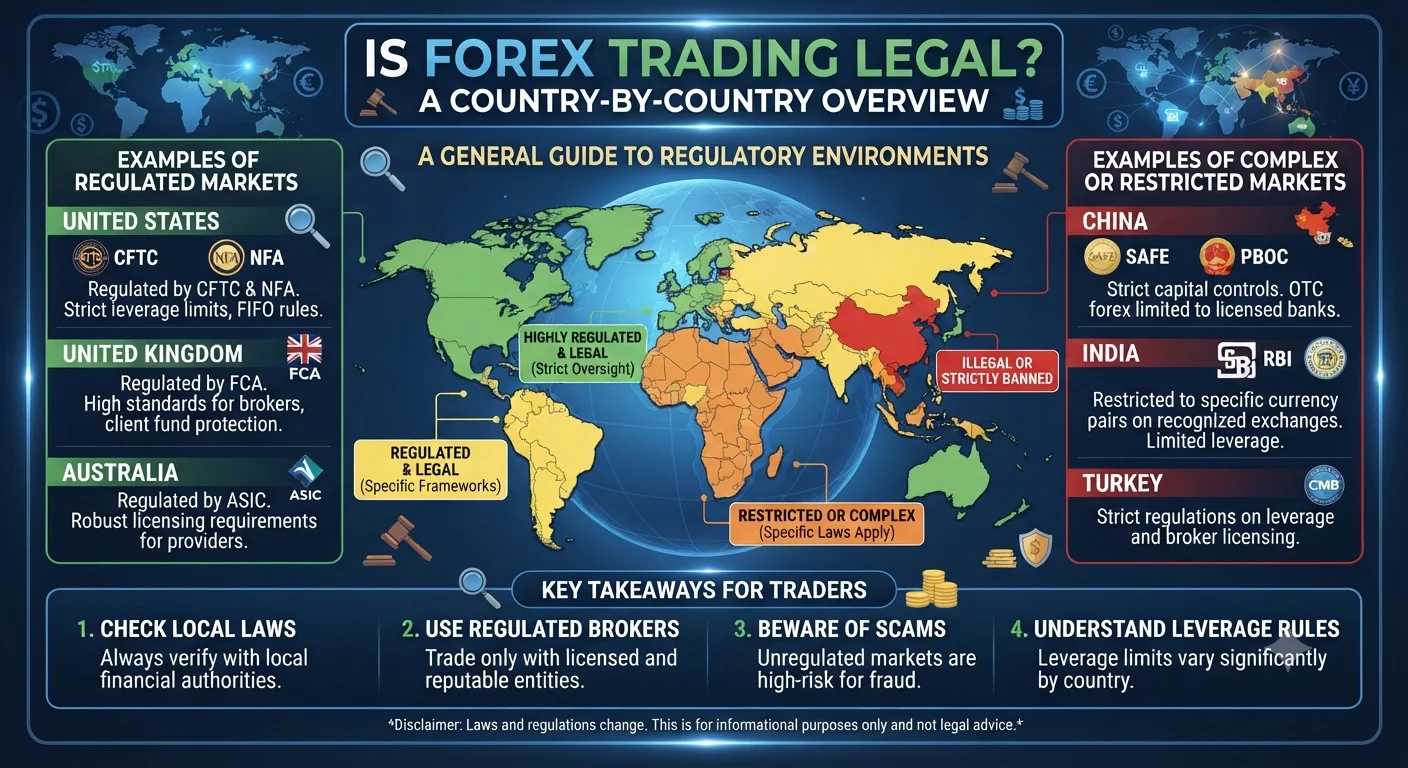
Forex trading is legal in the majority of countries around the world. However the legal framework varies significantly from one jurisdiction to another. In some countries forex trading by retail individuals is actively regulated and protected by government agencies. In others it exists in a legal grey area. And in a small number of countries it is restricted or prohibited entirely. Knowing the legal status in your country and choosing a properly regulated broker is the foundation of safe trading.
Quick Answer: Is Forex Trading Legal?
Yes. Retail forex trading is legal in most major economies including the United States, the United Kingdom, the European Union, Australia, Canada, Japan, Singapore, South Africa and most of Asia, Latin America and the Middle East.
What varies between countries is:
- Which regulatory body oversees forex brokers
- What protections retail traders have under local law
- What leverage limits apply to retail accounts
- Whether offshore brokers can legally accept clients from that country
The legal status of forex trading and the regulation of forex brokers are two separate questions. Trading forex can be legal in your country even if you use a broker based in another jurisdiction.
Country-by-Country Legal Status Overview
- Quick Answer: Is Forex Trading Legal?
- Country-by-Country Legal Status Overview
- United States
- United Kingdom
- European Union
- Australia
- Canada
- Japan
- Singapore
- United Arab Emirates
- South Africa
- Pakistan
- India
- China
- Nigeria
- What Determines Whether Your Trading Is Legal
- Frequently Asked Questions
- Q: Is forex trading legal in my country?
- Q: Do I need a licence to trade forex as an individual?
- Q: Is it legal to use an offshore forex broker?
- Q: Are forex trading profits taxable?
- Q: What happens if I trade with an unregulated broker?
United States
Forex trading is legal and heavily regulated in the United States. The primary regulators are the Commodity Futures Trading Commission (CFTC) and the National Futures Association (NFA). US-based forex brokers must be registered with both bodies.
US regulation is among the strictest in the world. Maximum leverage for major currency pairs is limited to 50:1 for retail traders. Many offshore brokers do not accept US clients because of the compliance burden.
Status: Legal and heavily regulated
United Kingdom
Forex trading is legal and regulated by the Financial Conduct Authority (FCA). The UK has one of the most respected regulatory frameworks for retail forex in the world.
FCA-regulated brokers must provide negative balance protection, keep client funds in segregated accounts and contribute to the Financial Services Compensation Scheme (FSCS) which protects eligible clients for up to £85,000 if a broker becomes insolvent.
Maximum leverage for retail clients under FCA rules is 30:1 on major currency pairs.
Status: Legal and regulated by the FCA
European Union
Forex trading is legal across the European Union. The regulatory framework is set by the European Securities and Markets Authority (ESMA) and implemented by national regulators in each member state. Major national regulators include CySEC (Cyprus), BaFin (Germany) and AMF (France).
ESMA rules require negative balance protection and limit retail leverage to 30:1 on major pairs across all EU member states.
Status: Legal and regulated under ESMA framework
Australia
Forex trading is legal and regulated by the Australian Securities and Investments Commission (ASIC). ASIC is widely regarded as one of the more rigorous retail forex regulators globally.
Maximum leverage for retail traders under ASIC rules was reduced to 30:1 on major currency pairs in 2021, bringing it in line with UK and EU standards.
Status: Legal and regulated by ASIC
Canada
Forex trading is legal in Canada but the regulatory framework is fragmented across provincial regulators rather than a single national body. The main regulators are the Investment Industry Regulatory Organization of Canada (IIROC) at the national level and provincial securities commissions.
Relatively few forex brokers are fully registered in Canada and many Canadians use offshore regulated brokers. Operating a forex brokerage without proper registration is illegal in Canada.
Status: Legal with provincial regulatory oversight
Japan
Japan has one of the most developed retail forex markets in the world. Forex trading is legal and regulated by the Financial Services Agency (FSA) and the Financial Futures Association of Japan (FFAJ).
Japan had historically very high leverage limits for retail traders but these were significantly reduced over time. Current maximum leverage is 25:1 for retail forex traders.
Status: Legal and regulated by the FSA
Singapore
Forex trading is legal and regulated by the Monetary Authority of Singapore (MAS). Singapore is a major global financial hub and MAS is considered one of the most competent regulatory bodies in Asia.
Status: Legal and regulated by MAS
United Arab Emirates
Forex trading is legal in the UAE. Regulation operates through two bodies depending on location: the Dubai Financial Services Authority (DFSA) for brokers operating in the Dubai International Financial Centre (DIFC) and the Securities and Commodities Authority (SCA) for the wider UAE market.
Recommended Articles
 FOREX REGULATIONS LEGAL GUIDES
Status: Legal with regulated frameworks in place
South Africa
Forex trading is legal in South Africa and regulated by the Financial Sector Conduct Authority (FSCA). South Africa has a growing retail forex market and the FSCA actively licenses and supervises forex brokers operating in the country.
Status: Legal and regulated by the FSCA
Pakistan
Forex trading exists in a legal grey area in Pakistan. The State Bank of Pakistan (SBP) regulates foreign exchange transactions but retail speculative forex trading through international online brokers is not formally licensed or regulated domestically. Many Pakistani traders use offshore regulated brokers.
Status: Not explicitly prohibited but not formally regulated for retail
India
Forex trading in India is restricted. The Reserve Bank of India (RBI) and the Securities and Exchange Board of India (SEBI) permit currency trading only in INR-based currency pairs on recognised exchanges such as the NSE and BSE. Trading other currency pairs through offshore brokers is not permitted under FEMA (Foreign Exchange Management Act) regulations.
Status: Restricted to exchange-traded INR pairs only
China
Retail forex trading through international online brokers is prohibited for Chinese mainland residents. The People's Bank of China (PBoC) and SAFE (State Administration of Foreign Exchange) tightly control all foreign exchange activity. Legitimate forex trading for businesses exists but speculative retail trading through offshore platforms is illegal.
Status: Prohibited for retail individuals on mainland China
Nigeria
Forex trading is legal in Nigeria and the market is one of the largest in Africa. The Securities and Exchange Commission (SEC) Nigeria and the Central Bank of Nigeria (CBN) have both issued guidance on forex trading regulation. Many Nigerians trade through internationally regulated offshore brokers.
Status: Legal with regulatory guidance in place
What Determines Whether Your Trading Is Legal
Regardless of your country the following factors determine whether your specific forex trading activity is on the right side of the law:
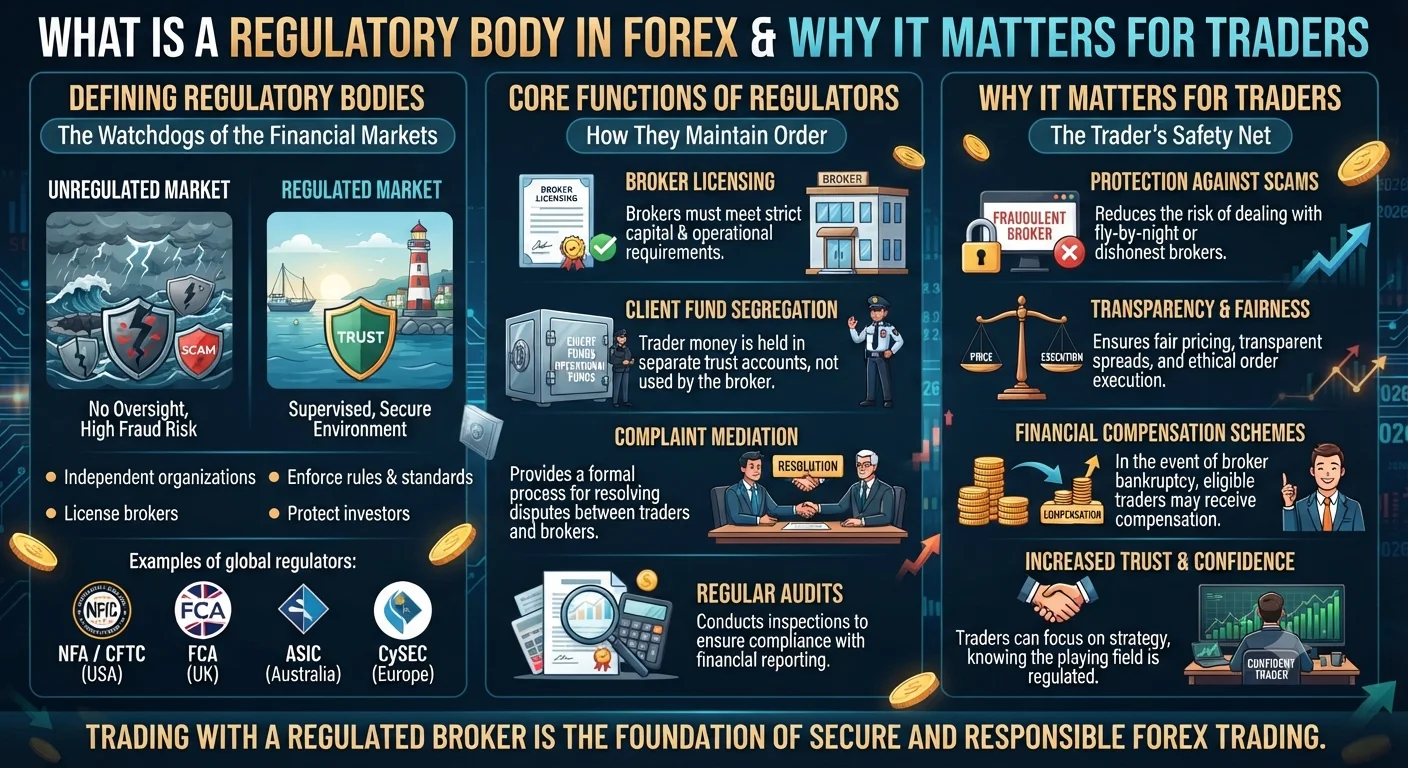
Using a properly regulated broker: Trading through a broker regulated by a recognised authority (FCA, ASIC, CySEC etc.) provides legal protection and ensures the broker operates within a framework of rules designed to protect you.
Declaring taxable income: In most jurisdictions forex trading profits are subject to income tax or capital gains tax. Failing to declare trading profits is a legal matter entirely separate from the legality of the trading itself.
Following local foreign exchange rules: Some countries restrict how much foreign currency an individual can hold or transfer offshore. These restrictions apply to the movement of funds not necessarily to the trading activity itself.
Not using prohibited platforms: In countries where retail forex is restricted using offshore platforms that specifically target residents may violate local financial regulations even if those platforms are regulated elsewhere.
Frequently Asked Questions
Q: Is forex trading legal in my country?
For the vast majority of readers the answer is yes. Forex trading is legal in most countries in North America, Europe, Asia-Pacific, the Middle East and Africa. The notable exceptions include mainland China and a small number of countries with strict capital controls. Always check with your country's financial regulatory authority for the definitive answer.
Q: Do I need a licence to trade forex as an individual?
No. Individual retail traders do not need a licence to trade forex for their own account. Licences are required for companies and individuals who provide forex trading services to others such as brokers, fund managers and signal providers.
Q: Is it legal to use an offshore forex broker?
In most countries it is legal for individuals to open accounts with offshore brokers that are regulated in other jurisdictions. However in some countries such as the United States there are specific rules about which offshore brokers can accept clients. Using a broker that is regulated by a reputable authority (FCA, ASIC, CySEC) provides meaningful protection even if the broker is not based in your home country.
Q: Are forex trading profits taxable?
In most countries yes. Forex trading profits are generally treated as taxable income or capital gains depending on the jurisdiction and the nature of the trading activity. Tax rules for forex vary significantly between countries. Always consult a qualified tax professional in your country for advice specific to your situation.
Q: What happens if I trade with an unregulated broker?
Trading with an unregulated broker means you have no legal recourse if the broker withholds your funds, refuses withdrawals or becomes insolvent. There is no regulatory body to complain to and no compensation scheme protecting your deposit. This is one of the most serious risks in retail forex and is why broker regulation is the first and most important factor to check before depositing any funds.