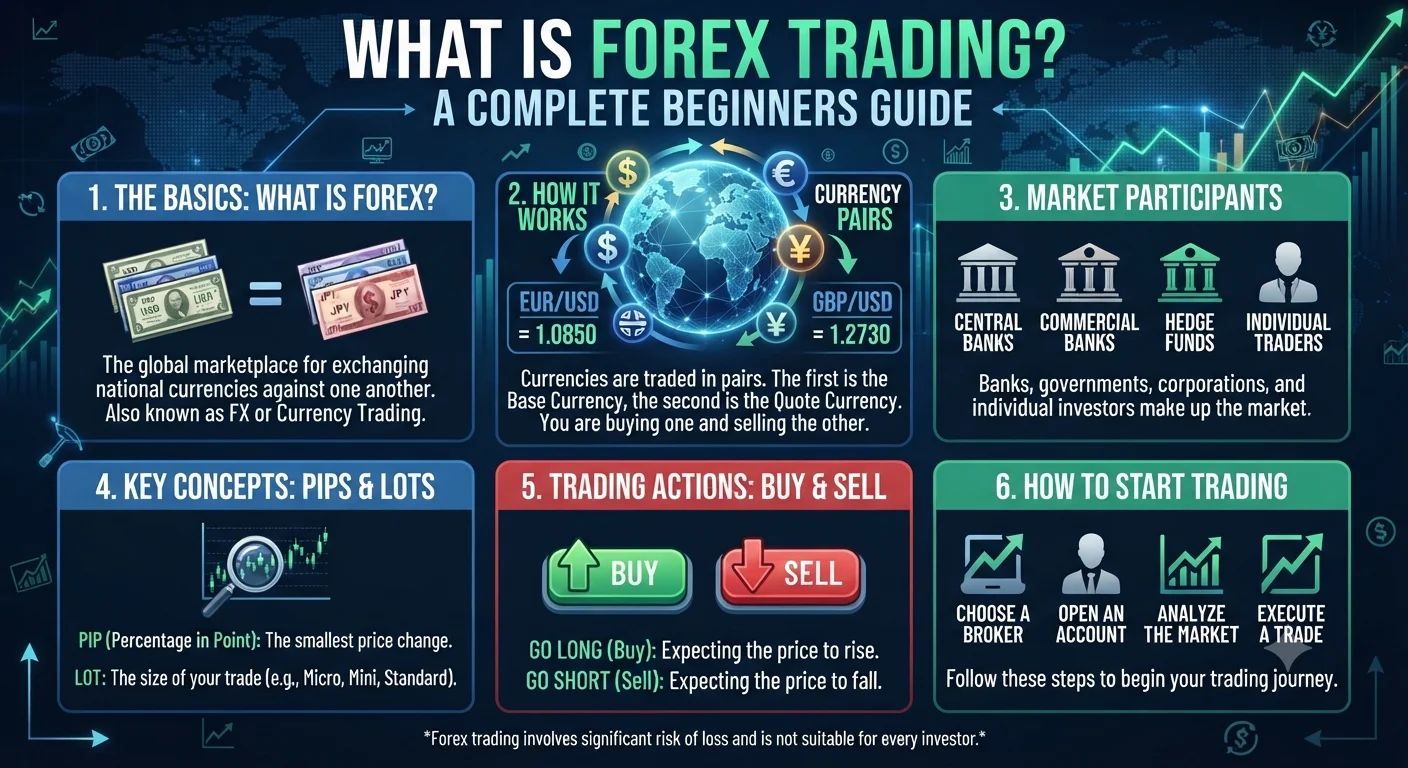
Forex trading is the buying and selling of currencies against each other on the global foreign exchange market. Traders profit — or lose — based on changes in the exchange rate between two currencies. It is the largest financial market in the world, with over $7.5 trillion traded every single day.
What Is Forex Trading? (Quick Definition)
Forex stands for foreign exchange. At its most basic level, every time someone converts one currency into another — a traveller swapping British pounds for US dollars at an airport, or a business paying an overseas supplier — they are participating in the forex market.
Professional forex trading takes this same principle and applies it speculatively. Traders try to predict which currency will rise or fall in value against another and place trades to profit from that movement.
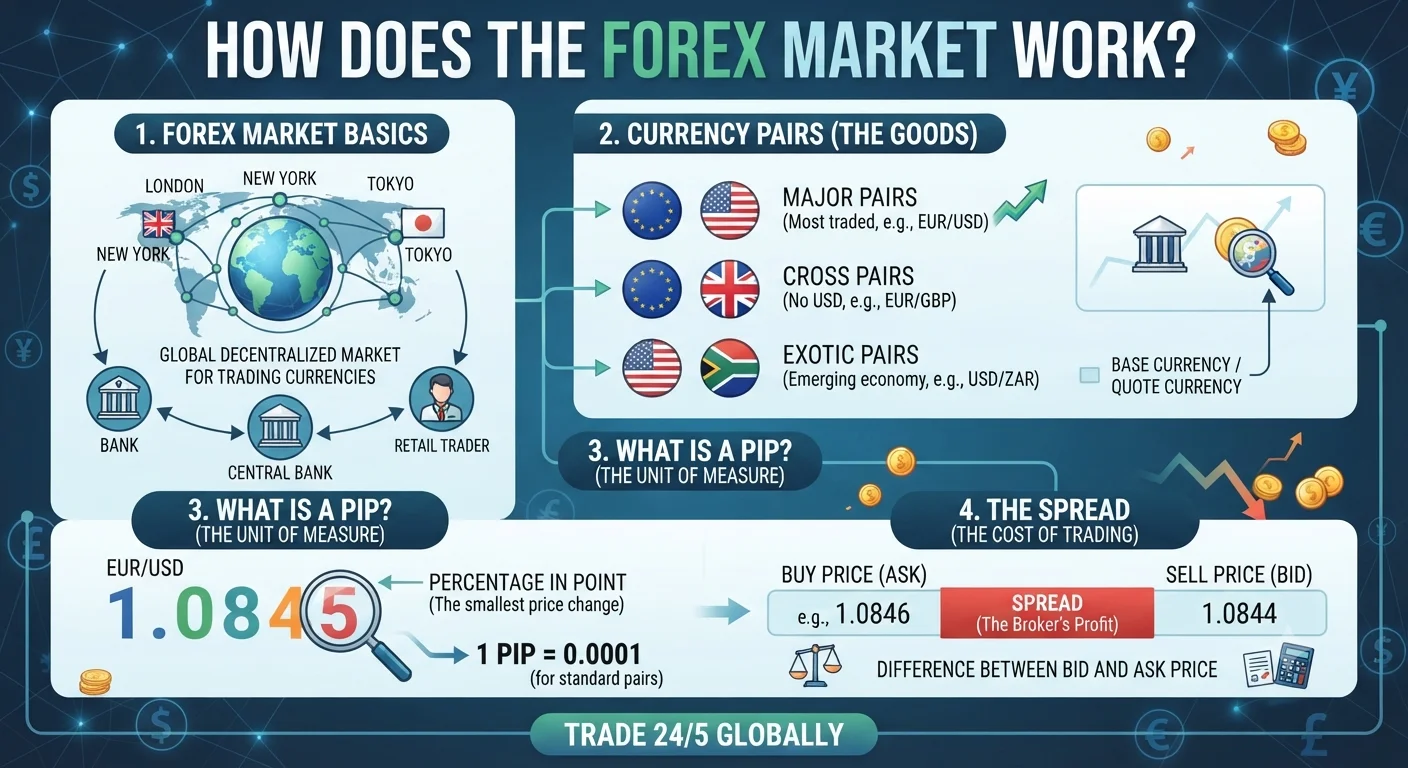
The forex market has no central exchange. Unlike stocks, which trade on the New York Stock Exchange or the London Stock Exchange, forex operates over-the-counter (OTC) — meaning trades happen directly between participants through an electronic network. This network runs 24 hours a day, five days a week, following the global business day from Sydney to Tokyo to London to New York.
How the Forex Market Works
- What Is Forex Trading? (Quick Definition)
- How the Forex Market Works
- Currency Pairs
- What Is a Pip?
- What Is the Spread?
- What Is Leverage?
- The Four Major Trading Sessions
- A Practical Example
- Why Understanding Forex Trading Matters for Your Results
- Frequently Asked Questions
- Q: Is forex trading legal?
- Q: How much money do I need to start forex trading?
- Q: Can you make money from forex trading?
- Q: What is the difference between forex trading and stock trading?
- Q: What is a forex broker?
Currency Pairs
Every forex trade involves two currencies, known together as a currency pair. The first currency is called the base currency and the second is the quote currency.
For example: EUR/USD = 1.0850
This means it costs 1.0850 US Dollars to buy one Euro. If you believe the Euro will strengthen against the Dollar, you buy EUR/USD. If you believe the Euro will weaken, you sell EUR/USD.
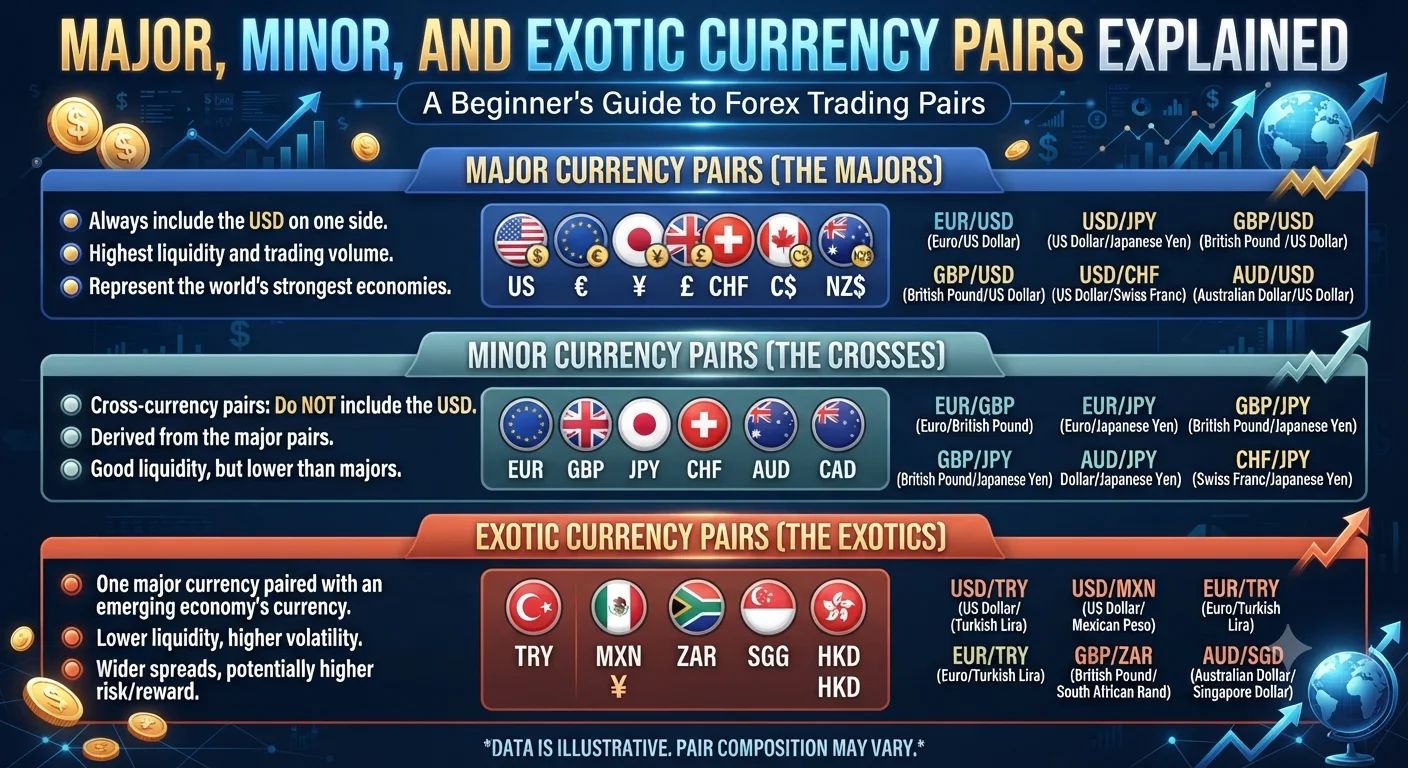
The three main groups of currency pairs are:
| Type | Examples | Characteristics |
|---|---|---|
| Major pairs | EUR/USD, GBP/USD, USD/JPY | Highest liquidity, tightest spreads |
| Minor pairs | EUR/GBP, AUD/NZD, GBP/JPY | Moderate liquidity, slightly wider spreads |
| Exotic pairs | USD/TRY, EUR/ZAR, GBP/SGD | Lower liquidity, wider spreads, higher volatility |
What Is a Pip?
A pip (percentage in point) is the smallest standard price movement in a currency pair. For most pairs, one pip equals 0.0001.
If EUR/USD moves from 1.0850 to 1.0860, it has moved 10 pips. Your profit or loss on a trade is calculated by multiplying the number of pips moved by the pip value of your position size.
What Is the Spread?
The spread is the difference between the buy price (ask) and the sell price (bid) quoted by your broker. This is the broker's primary cost on each trade. If EUR/USD is quoted as 1.0849 / 1.0851, the spread is 2 pips.
What Is Leverage?
Most retail forex traders use leverage — the ability to control a position larger than your actual deposit. A broker offering 30:1 leverage means a $1,000 deposit can control a $30,000 position.
Leverage amplifies profits, but it amplifies losses equally. This is why leverage is one of the most important risk factors in forex trading and must be used carefully.
The Four Major Trading Sessions
The forex market runs continuously because it follows the sun across time zones. Understanding the sessions helps traders know when their chosen currency pairs are most active.
| Session | Opens (GMT) | Closes (GMT) | Most Active Pairs |
|---|---|---|---|
| Sydney | 10:00 PM | 7:00 AM | AUD/USD, NZD/USD |
| Tokyo | 12:00 AM | 9:00 AM | USD/JPY, EUR/JPY |
| London | 8:00 AM | 5:00 PM | EUR/USD, GBP/USD |
| New York | 1:00 PM | 10:00 PM | USD pairs, crosses |
The London–New York overlap (1:00 PM to 5:00 PM GMT) is typically the highest-volume and most volatile period of the trading day — often offering the best trading opportunities and the tightest spreads.
Recommended Articles
 FOREX TRADING BASICS
 FOREX TRADING BASICS
A Practical Example
Suppose you analyse the EUR/USD chart and believe the Euro will strengthen over the next 24 hours based on a positive Eurozone economic report. You open a buy trade (go long) at 1.0850 with a mini lot (10,000 units).
The next morning, EUR/USD rises to 1.0890 — a move of 40 pips in your favour.
Calculation:
- On a mini lot, each pip on EUR/USD is worth approximately $1.00
- 40 pips × $1.00 = $40 profit (before spread)
Had the price dropped 40 pips instead, your loss would be $40. This is why position sizing and stop-loss orders are essential before any trade is placed.
Why Understanding Forex Trading Matters for Your Results
The majority of retail forex traders lose money. Regulatory disclosures from major regulated brokers consistently show that 70–80% of retail accounts lose money. Understanding what forex trading actually is — before touching real money — protects you from the most common and costly beginner mistakes:
- Mistaking leverage for free capital. A 100:1 leverage ratio means a 1% move against you wipes your entire deposit.
- Ignoring the spread and commission costs. Every trade has a cost. Frequent trading on wide-spread pairs adds up quickly.
- Underestimating news volatility. Major economic events — such as a US Federal Reserve interest rate decision or Non-Farm Payrolls (NFP) report — can move currency pairs by hundreds of pips within minutes.
- Trading without a risk management plan. No stop-loss means no defined exit from a losing trade.
Frequently Asked Questions
Q: Is forex trading legal?
Yes, retail forex trading is legal in most countries when conducted through a properly regulated broker. Common regulators include the FCA (UK), ASIC (Australia), and CySEC (Cyprus). Always verify your broker's regulatory status before depositing any funds.
Q: How much money do I need to start forex trading?
Many brokers allow accounts from as little as $10–$100 using micro or nano lots. However, responsible trading typically requires at least $500–$1,000 and trading minimum position sizes while you are learning. Starting with a free demo account first is strongly recommended.
Q: Can you make money from forex trading?
Some traders do make consistent profits from forex trading. However, regulatory disclosures from major brokers show that 70–80% of retail trader accounts lose money. Profitability requires a tested strategy, strict risk management, significant practice, and realistic expectations.
Q: What is the difference between forex trading and stock trading?
Forex trading involves currency pairs and runs 24/5 with very high liquidity and available leverage. Stock trading involves shares of companies, runs during exchange hours, and typically uses lower leverage. Forex markets are more directly and immediately affected by macroeconomic events such as interest rate decisions and inflation data.
Q: What is a forex broker?
A forex broker is a company that provides retail traders with access to the currency market, usually through a trading platform such as MetaTrader 4 or MetaTrader 5. Brokers make money through the spread and/or a per-trade commission. Choosing a regulated broker is essential for the safety of your funds.