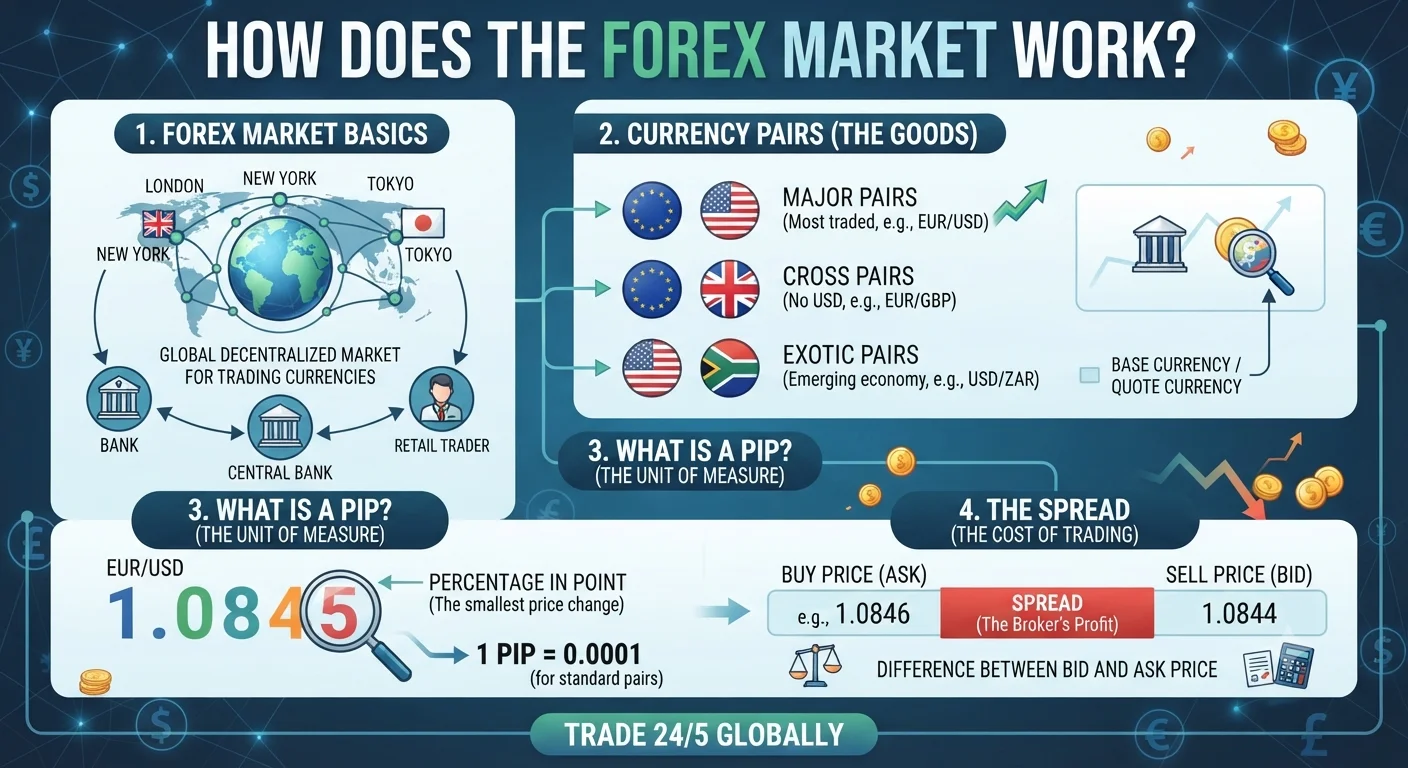
The forex market works by connecting buyers and sellers of currencies through an electronic network of banks, brokers and financial institutions that operates 24 hours a day five days a week. Traders buy one currency and simultaneously sell another, profiting or losing based on changes in the exchange rate between the two.
What the Forex Market Actually Is
The foreign exchange market has no central physical location. There is no forex equivalent of the New York Stock Exchange or the London Stock Exchange where all trades pass through a single point.
Instead the forex market is a global decentralised network operating over-the-counter (OTC). Trades happen electronically between participants directly. This network spans every financial centre in the world and because time zones overlap somewhere in the world is always open during weekdays.
The participants in this market range from the largest institutions in the world down to individual retail traders:
| Participant | Role |
|---|---|
| Central banks | Manage national currency reserves and sometimes intervene to stabilise exchange rates |
| Commercial banks | The primary source of market liquidity, trading enormous volumes daily |
| Hedge funds | Speculative trading for profit |
| Corporations | Buying foreign currencies to pay overseas suppliers or converting foreign revenue |
| Retail brokers | Provide access to the market for individual traders |
| Retail traders | Individual participants trading for profit or income |
The vast majority of daily trading volume comes from institutional participants. Retail traders represent a small fraction of total market activity but can still profit from price movements if they understand how the market works.
Understanding Currency Pairs
- What the Forex Market Actually Is
- Understanding Currency Pairs
- What Is a Pip?
- What Is the Spread?
- What Is Leverage?
- How a Forex Trade Actually Works
- Frequently Asked Questions
- Q: What moves currency prices in the forex market?
- Q: Can retail traders actually make money in the forex market?
- Q: What is the minimum amount needed to start trading forex?
- Q: What is the difference between a bid price and an ask price?
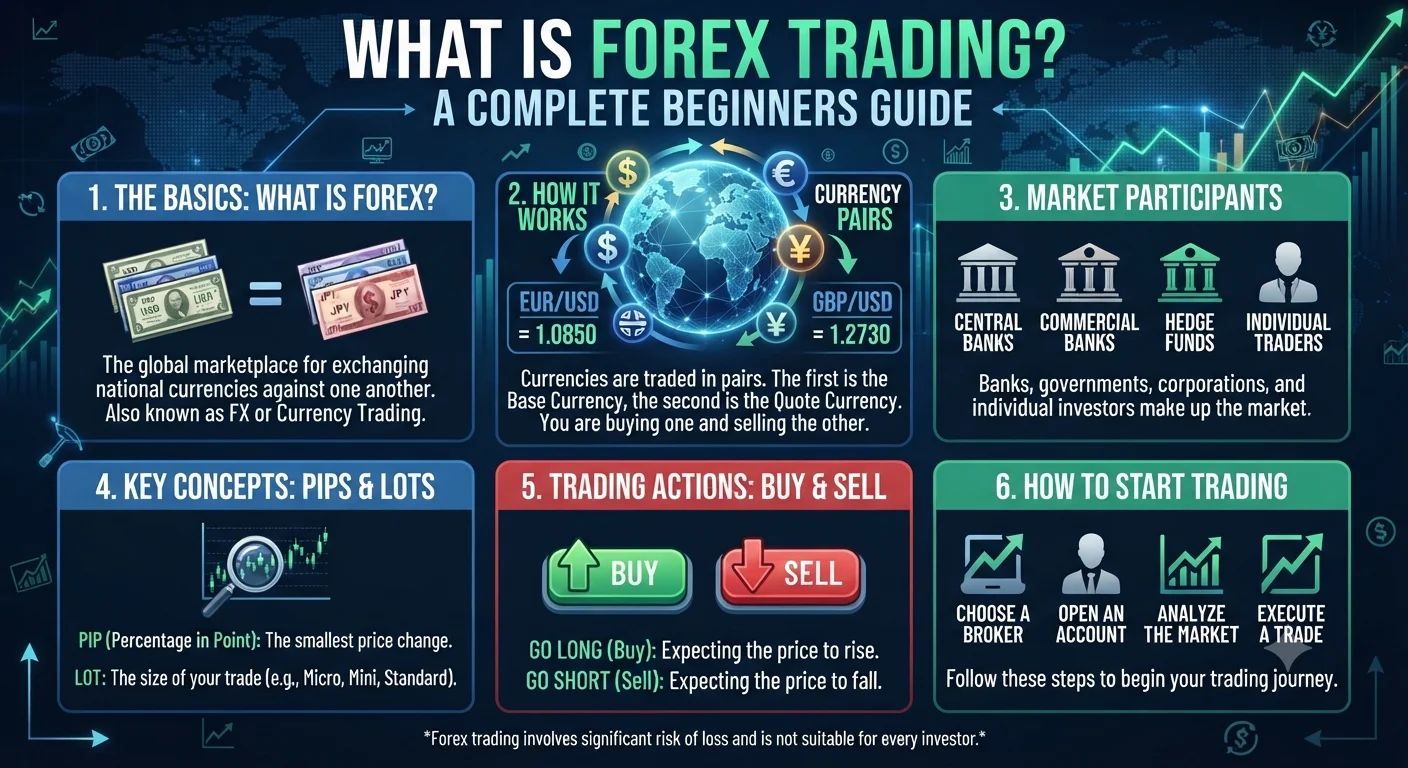
Every forex trade involves two currencies known as a currency pair. You are always buying one currency and selling the other simultaneously.
The structure of a currency pair:
EUR/USD = 1.0850
- EUR is the base currency (the one being bought or sold)
- USD is the quote currency (the one used to price the base)
- 1.0850 is the exchange rate: it costs 1.0850 US Dollars to buy one Euro
When you buy EUR/USD you are buying Euros and selling US Dollars. When you sell EUR/USD you are selling Euros and buying US Dollars.
The three categories of currency pairs:
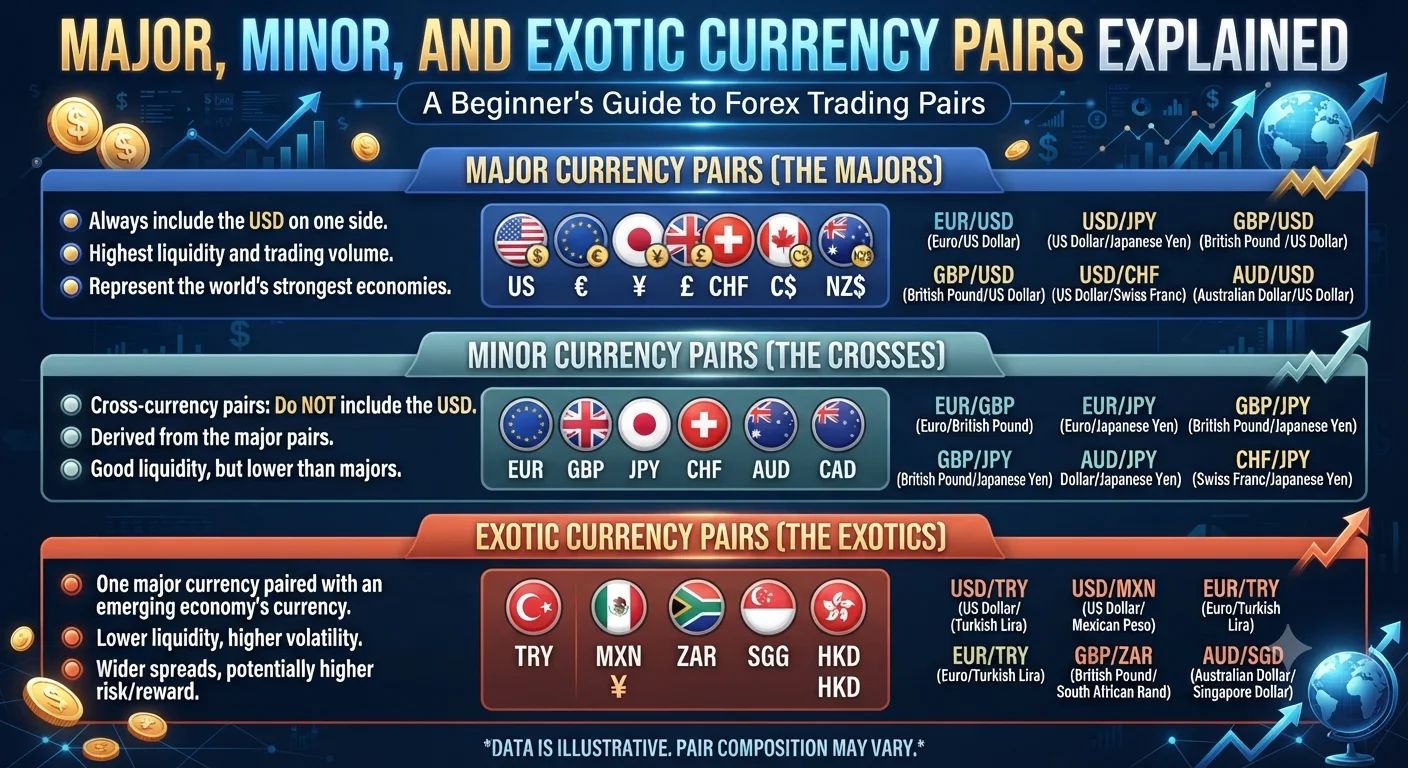
Major pairs include the US Dollar and one of the other most traded currencies in the world. They have the highest liquidity and the tightest spreads. Examples include EUR/USD, GBP/USD, USD/JPY, AUD/USD and USD/CAD.
Minor pairs do not include the US Dollar but involve two other major currencies. Examples include EUR/GBP, EUR/JPY and GBP/AUD. They have slightly wider spreads than majors.
Exotic pairs combine a major currency with a currency from a smaller or emerging economy. Examples include USD/TRY, EUR/ZAR and GBP/SGD. They have lower liquidity and much wider spreads.
What Is a Pip?
A pip stands for percentage in point. It is the standard unit of measurement for price movement in the forex market.
For most currency pairs one pip equals a movement of 0.0001 in the exchange rate.
Example: If EUR/USD moves from 1.0850 to 1.0860 the price has moved 10 pips.
For currency pairs involving the Japanese Yen (such as USD/JPY) one pip equals 0.01 because the Yen is quoted to two decimal places rather than four.
Why pips matter: Your profit or loss on any trade is calculated by multiplying the number of pips the price moved by the pip value of your position size. A larger position means each pip is worth more money in both directions.
| Position Size | EUR/USD Pip Value (approx) |
|---|---|
| 1 standard lot (100,000 units) | $10 per pip |
| 1 mini lot (10,000 units) | $1 per pip |
| 1 micro lot (1,000 units) | $0.10 per pip |
What Is the Spread?
The spread is the difference between the price at which you can buy a currency pair (the ask price) and the price at which you can sell it (the bid price).
Recommended Articles
 FOREX TRADING BASICS
 FOREX TRADING BASICS
Example:
EUR/USD Bid: 1.0848 | EUR/USD Ask: 1.0850
The spread here is 2 pips. When you open a trade you immediately start at a small disadvantage equal to the spread because the market needs to move in your favour by at least the spread amount before your trade is in profit.
The spread is the broker's primary source of revenue on each trade. Brokers that also charge a commission typically offer a much tighter raw spread alongside the fixed commission.
Factors that affect the spread:
- Liquidity: Highly liquid pairs like EUR/USD have very tight spreads. Exotic pairs have much wider spreads.
- Time of day: Spreads are tightest during the London and New York sessions when market liquidity is at its peak. They widen during quiet overnight periods.
- Market events: Spreads widen sharply immediately before and after major economic announcements as brokers reduce their exposure to sudden price moves.
What Is Leverage?
Leverage allows you to control a position much larger than your actual deposit. A broker offering 30:1 leverage means your $1,000 deposit can control a $30,000 position.
Leverage is expressed as a ratio:
| Leverage | Deposit Needed to Control $10,000 |
|---|---|
| 10:1 | $1,000 |
| 30:1 | $333 |
| 100:1 | $100 |
| 500:1 | $20 |
Leverage amplifies both profits and losses by exactly the same amount. A 1% price move on a 100:1 leveraged position produces a 100% gain or a 100% loss on the deposit. This is why proper position sizing and stop-loss orders are not optional in leveraged trading.
How a Forex Trade Actually Works
Here is a complete example of a single forex trade from start to finish:
- A trader analyses EUR/USD on the 4-hour chart and decides the Euro is likely to strengthen against the Dollar.
- The trader checks the economic calendar and confirms no high-impact news events are due in the next 12 hours.
- Using a position size calculator the trader determines they can buy 2 mini lots while risking no more than 1% of their account.
- The trader opens a buy order on EUR/USD at 1.0850. They set a stop-loss at 1.0820 (30 pips of risk) and a take-profit at 1.0910 (60 pips of reward). This is a 1:2 risk-to-reward ratio.
- EUR/USD rises as expected and reaches 1.0910. The take-profit order executes automatically.
- The trade closed with a 60-pip profit on 2 mini lots at $1 per pip equals $60 profit.
If the price had fallen to 1.0820 instead the stop-loss would have closed the trade automatically for a $30 loss (30 pips at $1 per pip).
Frequently Asked Questions
Q: What moves currency prices in the forex market?
Currency prices are driven by the interaction of supply and demand. The main factors that influence supply and demand include central bank interest rate decisions, inflation data, economic growth figures, employment reports, geopolitical events and overall market sentiment. The most powerful short-term drivers are central bank decisions and major economic data releases.
Q: Can retail traders actually make money in the forex market?
Some do. However regulatory disclosures from major brokers consistently show that 70 to 80% of retail accounts lose money over time. Those who are consistently profitable typically have a tested strategy, strict risk management rules and treat trading as a skilled discipline rather than a way to make quick money.
Q: What is the minimum amount needed to start trading forex?
Many brokers accept initial deposits from as little as $10 to $100. However trading responsibly with proper position sizing typically requires a minimum of $500 to $1,000. Starting with a free demo account before using real money is strongly recommended.
Q: What is the difference between a bid price and an ask price?
The bid price is the price at which you can sell a currency pair. The ask price is the price at which you can buy it. The ask is always slightly higher than the bid. The difference between them is the spread which is your transaction cost on each trade.