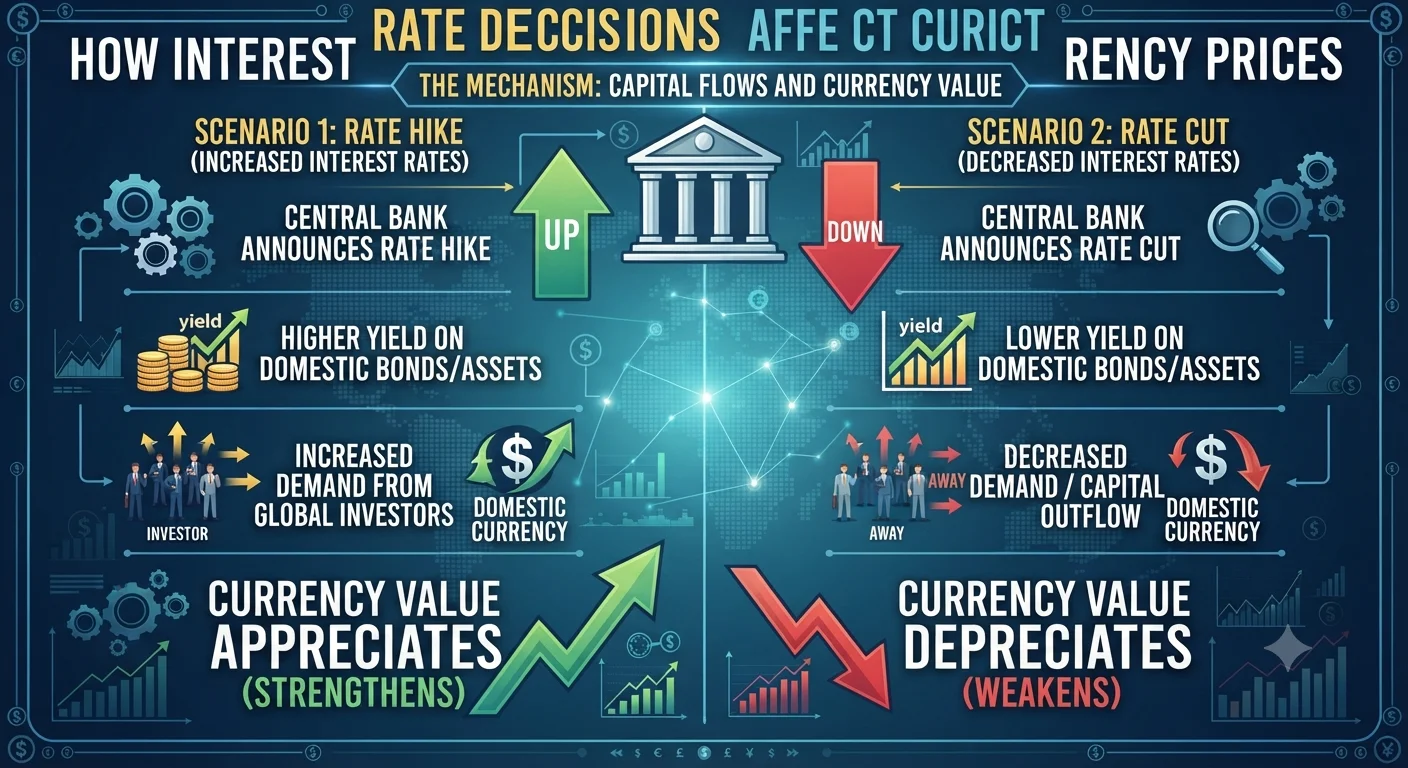
Interest rate decisions are the single most powerful driver of currency prices in the forex market. When a central bank raises interest rates the currency of that country typically strengthens. When a central bank cuts rates the currency typically weakens. Understanding why this happens and how to trade around it is one of the most valuable skills a forex trader can develop.
The Market Impact of Interest Rate Decisions
When a central bank announces a higher-than-expected interest rate the currency of that country tends to rise sharply in value against other currencies. When it announces a rate cut or signals that rates will stay lower for longer the currency tends to fall.
The reason is straightforward: higher interest rates attract more foreign capital into a country's savings accounts, government bonds and financial system. More demand for a country's currency to invest in those assets pushes the currency price up.
This relationship is one of the most reliable and well-documented patterns in the entire forex market.
What Is an Interest Rate Decision?
- The Market Impact of Interest Rate Decisions
- What Is an Interest Rate Decision?
- The Mechanism: Why Interest Rates Move Currency Prices
- Capital Flows and Yield Differentials
- The Role of Market Expectations
- Hawkish vs Dovish Language
- A Real-World Example
- How Traders Can Prepare for Rate Decisions
- Step 1: Mark the Date on the Economic Calendar
- Step 2: Understand Market Expectations Before the Announcement
- Step 3: Decide Your Trading Approach
- Step 4: Manage Risk Carefully Around Announcements
- Frequently Asked Questions
- Q: What happens to a currency when interest rates rise?
- Q: Why do currency markets move before the rate announcement is made?
- Q: What is the Federal Reserve and why does it matter for forex?
- Q: What does hawkish mean in forex?
- Q: How often do central banks make rate decisions?
An interest rate decision is an official announcement made by a country's central bank setting the benchmark interest rate for that economy. This rate directly influences:
- The interest paid on government bonds
- The rate banks charge each other for overnight lending
- Mortgage rates, savings rates and business loan rates across the entire economy
The most watched central banks in the world and their key interest rate tools:
| Central Bank | Country / Region | Key Rate Name |
|---|---|---|
| Federal Reserve (Fed) | United States | Federal Funds Rate |
| European Central Bank (ECB) | Eurozone | Main Refinancing Rate |
| Bank of England (BoE) | United Kingdom | Bank Rate |
| Bank of Japan (BoJ) | Japan | Short-Term Policy Rate |
| Reserve Bank of Australia (RBA) | Australia | Cash Rate |
| Swiss National Bank (SNB) | Switzerland | SNB Policy Rate |
Each of these institutions meets on a scheduled basis throughout the year to review and set their interest rate. These meeting dates are published in advance on the economic calendar and are among the most closely watched events in financial markets.
The Mechanism: Why Interest Rates Move Currency Prices
Understanding the mechanism behind this relationship allows traders to anticipate currency moves rather than simply react to them.
Capital Flows and Yield Differentials
The global financial system moves money constantly in search of the best return. Investors, institutions and governments compare interest rates across countries and move capital toward the places offering higher returns.
When the US Federal Reserve raises the Federal Funds Rate:
- US government bonds and savings accounts now pay a higher yield
- Investors around the world buy US Dollars to purchase those higher-yielding US assets
- Increased demand for US Dollars pushes the USD higher against other currencies
This is known as carry trade logic: money flows from low-interest-rate currencies toward high-interest-rate currencies because the yield differential creates a profit opportunity even without any price movement.
The Role of Market Expectations
Here is what most beginners miss: the forex market does not wait for the actual announcement. Traders begin pricing in rate expectations weeks or even months before the official decision.
By the time the announcement arrives the market has already moved based on what was expected. This creates two very different scenarios:
| Outcome | Market Reaction |
|---|---|
| Rate decision matches expectations | Little price movement because it was already priced in |
| Rate decision surprises the market | Large and fast price movement in the direction of the surprise |
| Rate held but language is more hawkish than expected | Currency strengthens on forward guidance alone |
| Rate held but language is more dovish than expected | Currency weakens despite no actual rate change |
Key insight: A central bank can move currency markets significantly without changing rates at all simply by changing the language of its statement. Words like "patient" or "data-dependent" versus "prepared to act" can cause hundreds of pips of movement.
Hawkish vs Dovish Language
These two terms are essential for understanding central bank communications:
Hawkish means the central bank is signalling concern about inflation and leaning toward raising interest rates. Hawkish language strengthens the currency.
Dovish means the central bank is signalling concern about economic growth and leaning toward cutting rates or keeping them low. Dovish language weakens the currency.
Recommended Articles
 MARKET NEWS ECONOMIC CONCEPTS
A Real-World Example
In March 2022 the US Federal Reserve began one of the most aggressive rate-hiking cycles in decades in response to inflation reaching 40-year highs. The Fed raised rates from near zero to over 5% across a series of meetings through 2022 and 2023.
During this period the US Dollar Index (DXY) which measures the Dollar against a basket of major currencies rose approximately 20% from its early 2022 level to its September 2022 peak.
The EUR/USD pair fell from above 1.1400 in early 2022 to below 1.0000 (parity) by September 2022 as the interest rate differential between the US and the Eurozone widened dramatically.
This is one of the clearest real-world demonstrations of how sustained rate hike cycles drive sustained currency trends over months and years.
How Traders Can Prepare for Rate Decisions
Step 1: Mark the Date on the Economic Calendar
Every major central bank announcement is listed on the economic calendar with its expected date and time. Rate decisions are typically marked as high impact events.
Use a free economic calendar such as those provided by Forex Factory or Investing.com to track upcoming rate decisions weeks in advance.
Step 2: Understand Market Expectations Before the Announcement
In the days leading up to a rate decision watch for:
- Analyst forecasts published by major banks
- Pricing in interest rate futures markets (CME FedWatch for the Federal Reserve)
- Recent economic data that may influence the decision such as inflation figures and employment reports
The market's current expectation is what matters. The announcement will be compared against that expectation not against the previous rate.
Step 3: Decide Your Trading Approach
There are two common approaches traders use around rate decisions:
Trading the expectation: Position yourself before the announcement based on your analysis of whether the outcome will be hawkish or dovish relative to market expectations. This carries the risk of being wrong about what the announcement contains.
Trading the reaction: Wait for the announcement to be released and the initial volatility to settle then trade the established new direction. This reduces the risk of being caught in the immediate spike but means missing the first large move.
Avoiding the event entirely: Many experienced traders close open positions before major rate decisions and sit out the announcement period. The extreme short-term volatility can trigger stop-losses even on correctly-directioned trades before the price settles in the right direction.
Step 4: Manage Risk Carefully Around Announcements
Interest rate announcements create some of the most extreme short-term volatility in the forex market. Within seconds of a release spreads widen dramatically and prices can move 50 to 100 pips or more.
If you hold positions through rate decisions:
- Ensure your stop-loss is placed beyond the realistic range of the announcement spike
- Never increase position size to try to profit from rate volatility unless you fully understand the risks
- Be aware that slippage is common during high-impact events meaning your stop-loss may execute at a worse price than set
Frequently Asked Questions
Q: What happens to a currency when interest rates rise?
When a central bank raises interest rates the currency of that country typically strengthens. Higher rates attract foreign capital seeking better returns on savings and bonds. Increased demand for the currency pushes its price up relative to other currencies. The size of the move depends on whether the rate hike was expected or a surprise.
Q: Why do currency markets move before the rate announcement is made?
Forex markets are forward-looking. Traders and institutions study economic data, central bank speeches and futures markets to predict what the rate decision will be weeks before the official announcement. By the time the announcement arrives much of the expected move has already happened. The biggest price movements occur when the actual decision differs from what the market was expecting.
Q: What is the Federal Reserve and why does it matter for forex?
The Federal Reserve is the central bank of the United States. Because the US Dollar is the world's primary reserve currency and is involved in approximately 88% of all forex transactions globally the Federal Reserve's interest rate decisions have the largest single impact of any central bank on currency markets worldwide.
Q: What does hawkish mean in forex?
Hawkish describes a central bank that is concerned about rising inflation and leaning toward increasing interest rates. When a central bank's statement or press conference is interpreted as more hawkish than the market expected the currency typically rises. The term comes from the idea of a hawk being more aggressive.
Q: How often do central banks make rate decisions?
Most major central banks meet to review interest rates approximately 8 times per year on a scheduled calendar. The Federal Reserve for example holds 8 scheduled Federal Open Market Committee (FOMC) meetings per year. These dates are published months in advance so traders can plan around them.