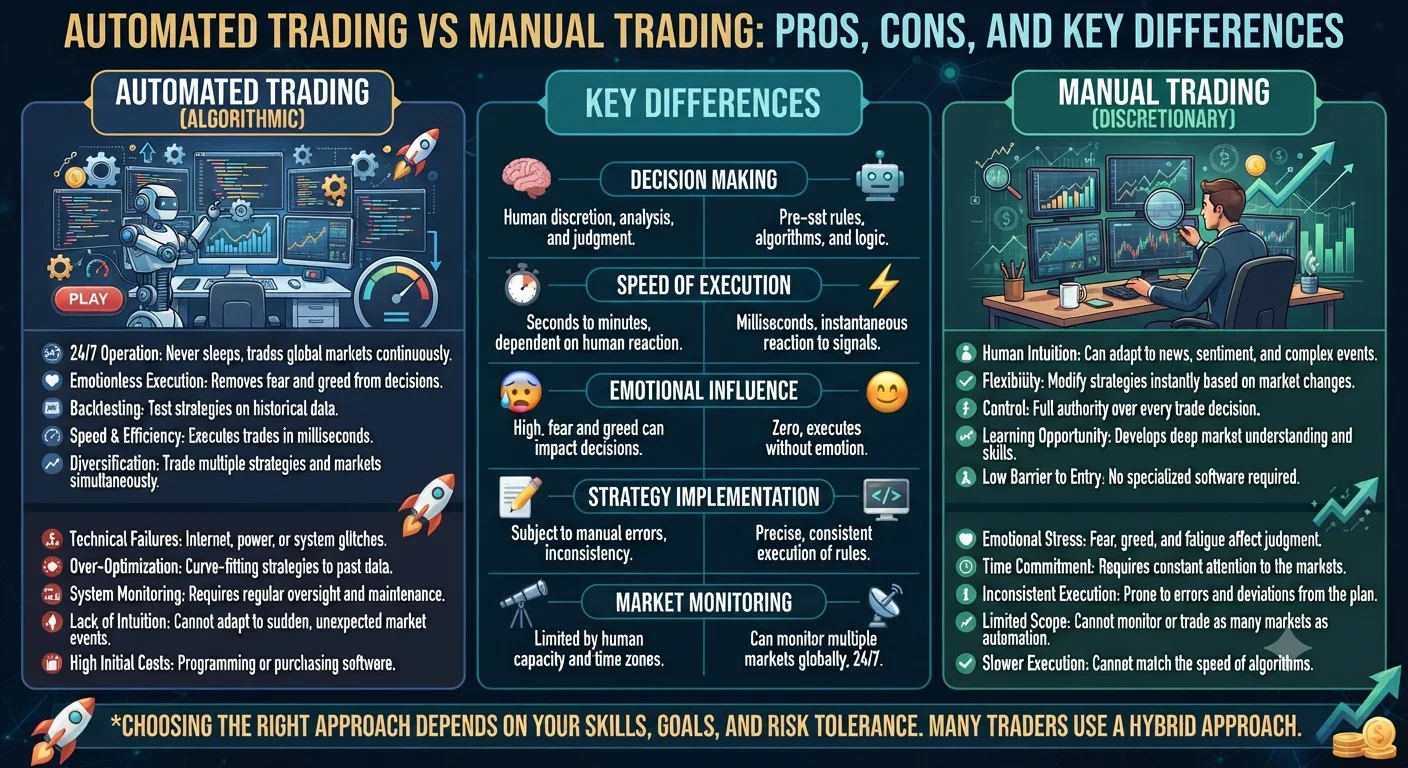
Automated trading uses a software program to place trades based on pre-defined rules without human intervention. Manual trading involves a human analysing the market, making decisions and placing orders directly. Both approaches can be profitable and both carry risk. The right choice depends on your strategy, your skills, your available time and your honest assessment of your own emotional discipline.
Quick Answer: The Key Difference at a Glance
The core difference between automated and manual trading is not which one makes more money. It is where the decision-making responsibility sits.
In manual trading the trader makes every decision. Human judgment, experience and discretion drive every entry, every exit and every risk management choice. This is powerful when the trader is skilled and disciplined. It becomes destructive when emotion overrides the trading plan.
In automated trading the software makes every decision according to its pre-programmed rules. Human judgment is applied during the development and testing phase. Once the system goes live it operates without emotional interference. This is powerful when the underlying strategy has a genuine edge. It becomes destructive when the strategy is flawed or market conditions change in ways the system cannot recognise.
Understanding Automated Trading
- Quick Answer: The Key Difference at a Glance
- Understanding Automated Trading
- What It Is
- Genuine Advantages
- Real Risks and Limitations
- Understanding Manual Trading
- What It Is
- Genuine Advantages
- Real Risks and Limitations
- Side-by-Side Comparison
- Which One Should You Choose?
- Frequently Asked Questions
- Q: Which is more profitable, automated or manual trading?
- Q: Can I start automated trading without knowing how to code?
- Q: Does automated trading work on a small account?
- Q: How much does it cost to run an automated trading system?
What It Is
Automated trading uses a program, called an Expert Advisor (EA) in MetaTrader or a trading bot on other platforms, to monitor price conditions and execute trades when pre-defined criteria are met. The trader designs the rules, tests the system on historical data and then runs it live without placing individual trades manually.
Genuine Advantages
Emotional consistency: The system follows its rules on every single trade without fear, greed, hesitation or revenge trading. This is arguably the most significant benefit because emotional inconsistency is one of the primary causes of retail trader failure.
Speed of execution: An EA can identify a condition and place an order in milliseconds. This matters for strategies that depend on precise entry timing or that trade during high-speed price movements.
24-hour operation: An automated system running on a Forex VPS trades across all sessions including the Tokyo session at 2 AM and the London open while the trader is at work or asleep.
Backtesting capability: Trading rules can be tested against years of historical data before risking real money. This provides objective evidence about a strategy's past performance.
Handling multiple pairs simultaneously: A well-designed system can monitor and trade ten or twenty currency pairs at once. A manual trader realistically cannot give full attention to more than three or four.
Real Risks and Limitations
The strategy must work first: Automation amplifies whatever the underlying strategy does. A losing strategy executed with perfect consistency and speed will lose money faster than a human making the same decisions manually.
Over-optimisation: EAs are frequently built to perform well on historical data but fail on new data. This is known as curve fitting and is one of the most common reasons why live EA performance disappoints after strong backtesting results.
No adaptation to changing conditions: A manual trader can observe that market conditions have changed and adjust their approach. An EA cannot unless specifically coded to recognise regime changes. A trend-following EA running in a ranging market will continue placing trend trades that consistently lose.
Technical failure risk: Platform crashes, internet disconnections and broker outages can leave automated positions open and unmanaged, particularly without a Forex VPS.
Understanding Manual Trading
What It Is
Manual trading means the trader personally analyses charts, interprets indicators, reads economic news and decides when to enter and exit trades. Every order is placed by the trader directly.
Genuine Advantages
Adaptability: A skilled manual trader observes in real time that the market has shifted from trending to ranging conditions and adjusts their entries, exits and strategy accordingly. No programming is required to respond to a new market environment.
Discretionary judgment: Some of the most important trading signals are not easily quantifiable. The overall structure of a chart, the quality of a candlestick pattern at a key level and the context provided by recent news can all inform a decision in ways that are difficult to code.
No technical infrastructure required: Manual trading requires only a trading platform and an internet connection. There is no need for VPS hosting, EA development or programming knowledge.
Recommended Articles
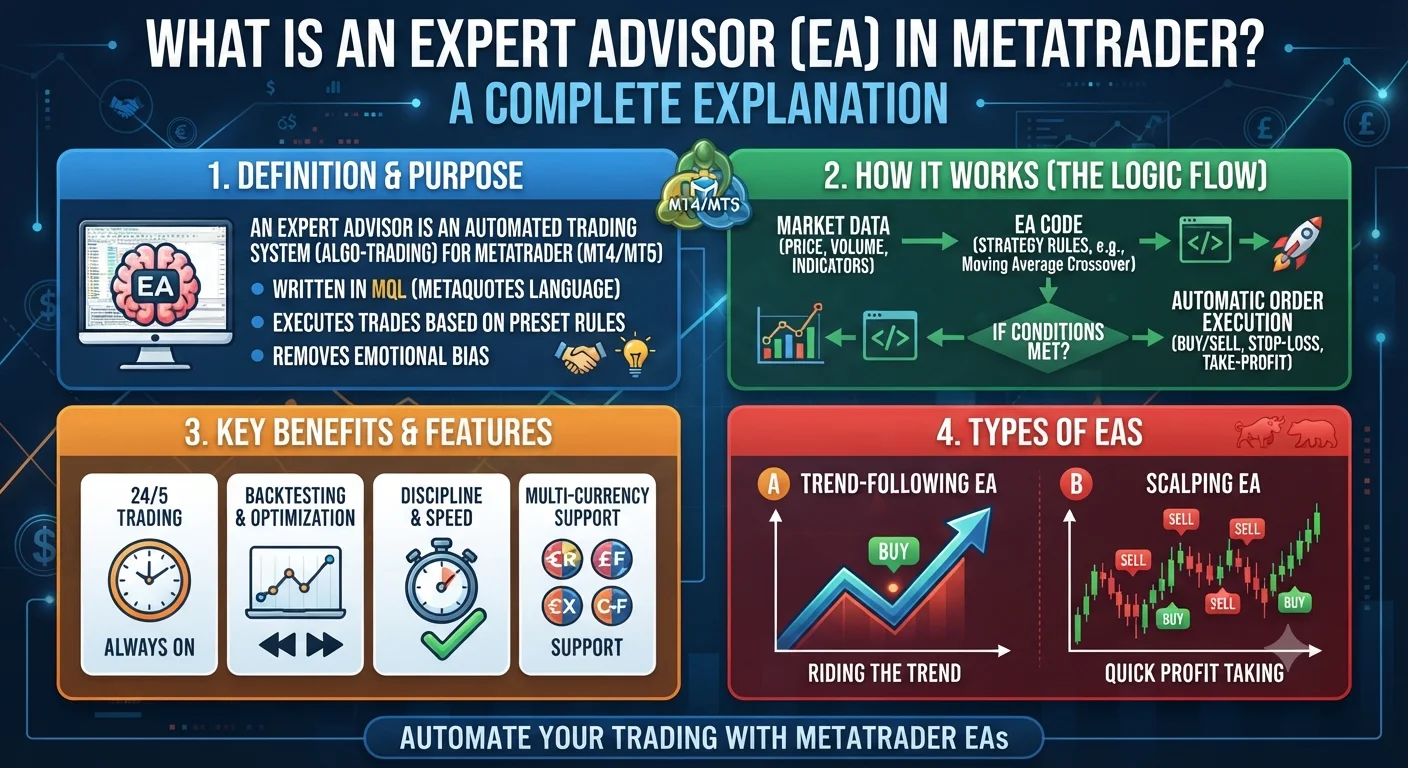 AUTOMATED TRADING EXPERT ADVISORS
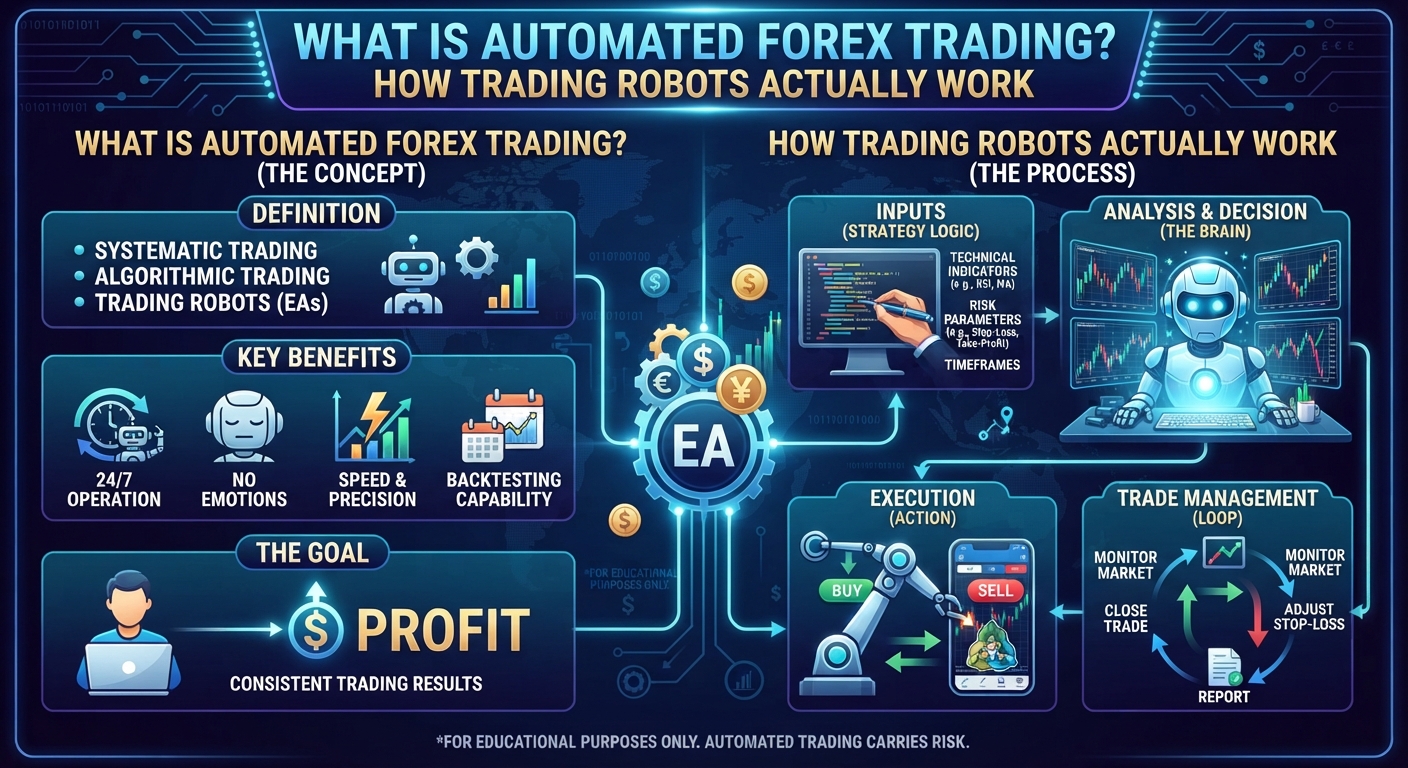 AUTOMATED TRADING EXPERT ADVISORS
Continuous learning: Every manually placed trade requires the trader to engage with the market, form a view and accept responsibility for the outcome. This creates faster development of real market understanding than passively watching an EA trade.
- What Is an Expert Advisor (EA) in MetaTrader? A Complete Explanation
- What Is Automated Forex Trading? How Trading Robots Actually Work
Real Risks and Limitations
Emotional interference: Fear of losing, reluctance to take a stop-loss, revenge trading after a loss and overconfidence after a winning streak all distort decision-making. Emotional trading is the single largest cause of retail account losses.
Time requirement: Active manual trading requires significant time in front of the screen. Day trading and scalping particularly demand sustained attention during market hours which is not compatible with most full-time employment schedules.
Inconsistency: Manual traders often apply their rules differently depending on their mood, their recent results or their emotional state at the time of the trade. This inconsistency makes it very difficult to evaluate whether a strategy has genuine edge or whether results reflect randomness.
Fatigue: Trading requires concentration. Decision quality deteriorates after extended screen time, after a sequence of losses or during periods of stress.
Side-by-Side Comparison
| Factor | Automated Trading | Manual Trading |
|---|---|---|
| Emotional discipline | High (no emotions involved) | Variable (depends entirely on the trader) |
| Execution speed | Milliseconds | Seconds to minutes |
| Operating hours | 24 hours with VPS | Only when trader is present |
| Adaptability to market change | Low (must be reprogrammed) | High (discretionary adjustment) |
| Learning curve | High (strategy and technical setup) | High (market analysis and discipline) |
| Strategy requirement | Fully quantifiable rules required | Discretionary judgment allowed |
| Technical requirements | Platform, VPS, EA development | Platform and internet connection |
| Backtesting | Yes | Limited (can journal and review manually) |
Which One Should You Choose?
There is no universally correct answer. Both approaches are used successfully by retail traders. The better question is which approach suits your current situation:
Choose automated trading if you have a clearly defined, testable strategy that can be expressed as specific rules, you are comfortable with the development and testing process or can work with a programmer, and you understand that the EA is only as good as the strategy it runs.
Choose manual trading if you are still developing your market understanding and want the learning experience of making your own decisions, you can dedicate the necessary screen time during active trading sessions and you have the emotional discipline to follow your plan consistently.
Many traders use both: A common hybrid approach is to use manual trading to develop and refine a strategy over months, then automate the most rule-based elements of that strategy once the approach has been thoroughly validated through personal trading.
Frequently Asked Questions
Q: Which is more profitable, automated or manual trading?
Neither is inherently more profitable than the other. Profitability depends on the quality of the underlying strategy and the consistency of its application, not the method of execution. A poorly designed EA will lose just as consistently as an undisciplined manual trader. A well-tested automated system can generate consistent results that many manual traders struggle to match because it eliminates emotional interference.
Q: Can I start automated trading without knowing how to code?
Yes. Many brokers and third-party developers offer pre-built Expert Advisors. Copy trading platforms allow you to automatically replicate the trades of experienced traders without any programming. However understanding the basic logic of what your automated system is doing is important for evaluating it honestly and monitoring it appropriately.
Q: Does automated trading work on a small account?
Yes but position sizing constraints apply. On a very small account such as $100 to $200 the minimum lot sizes required by most brokers limit how precisely position size can be calibrated to match the correct risk percentage per trade. A minimum account of $500 to $1,000 generally provides enough flexibility for proper automated risk management.
Q: How much does it cost to run an automated trading system?
The primary ongoing cost is a Forex VPS if you want 24-hour operation. Quality forex VPS services typically cost between $10 and $30 per month. The EA itself may be free or purchased for a one-time or subscription fee. There are no special trading costs beyond the normal spread and commission charged by your broker on each trade.