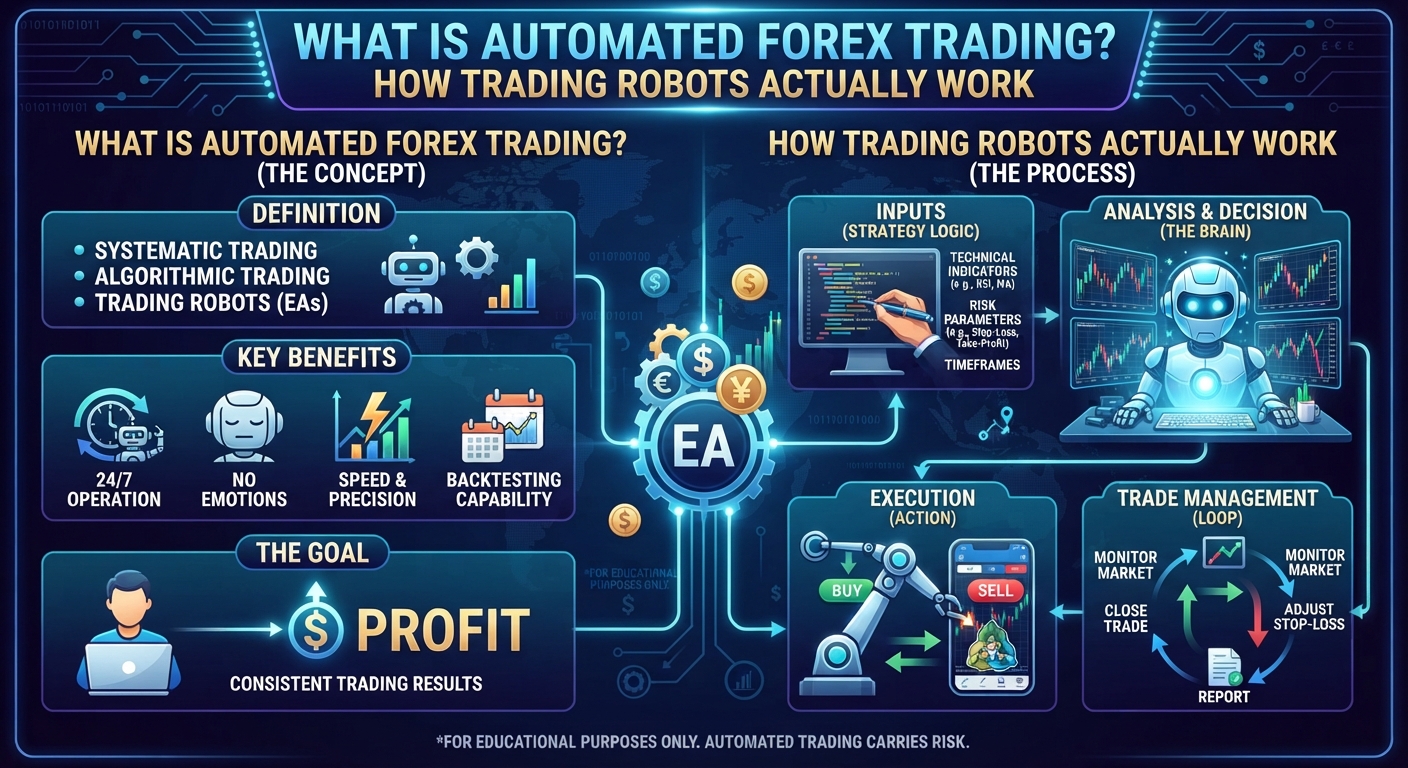
Automated forex trading is the use of a computer program commonly called a trading robot or Expert Advisor (EA) to execute buy and sell trades automatically, based on a pre-written set of rules. The program monitors the market, identifies conditions that match its strategy, and places trades without any human intervention.
Quick Definition: What Is Automated Forex Trading?
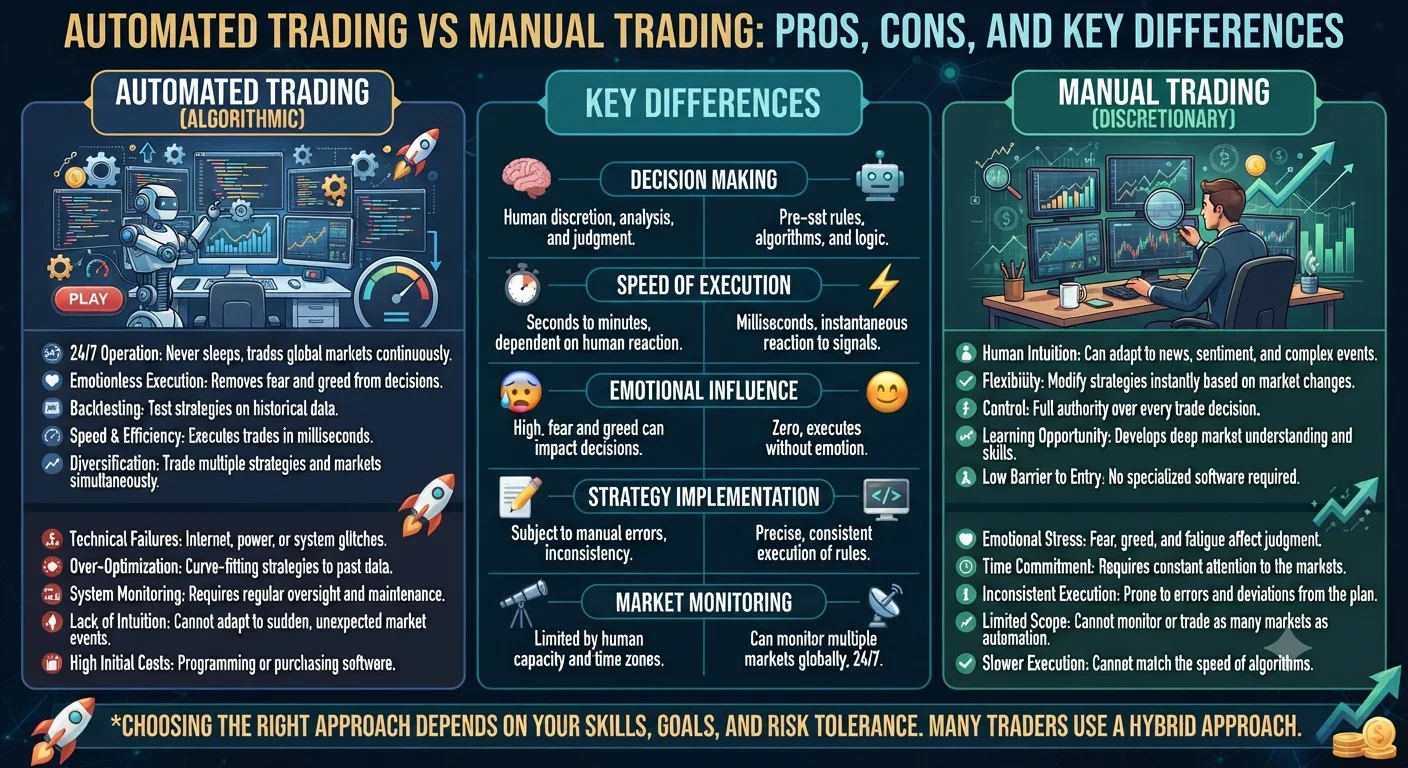
In manual trading, a human watches charts, makes decisions, and clicks buttons to place trades. In automated trading, a software program does all of that based on rules the trader or a programmer has defined in advance.
Those rules can be simple, such as:
"Buy EUR/USD when the 50-period moving average crosses above the 200-period moving average."
Or they can be highly complex, incorporating dozens of technical indicators, time-of-day filters, volatility checks, and sophisticated risk management conditions.
Once programmed, the robot monitors the market continuously and executes trades the instant its conditions are met — without hesitation, emotion, or fatigue.
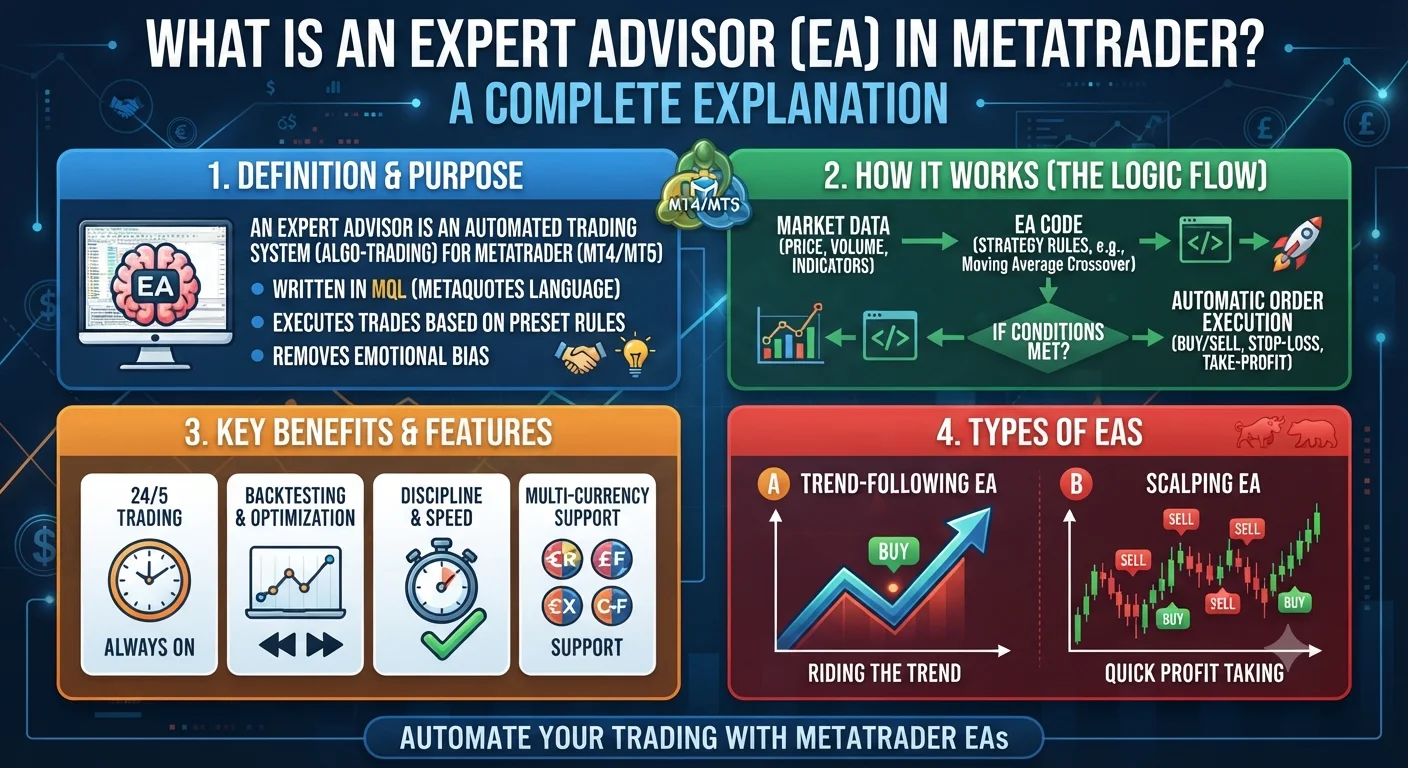
💡 Key Term: An Expert Advisor (EA) is the specific name for an automated trading script used on the MetaTrader 4 and MetaTrader 5 platforms. EAs are written in a programming language called MQL4 or MQL5. "Trading robot," "trading bot," and "EA" all refer to the same concept.
How Automated Forex Trading Works
- Quick Definition: What Is Automated Forex Trading?
- How Automated Forex Trading Works
- Where Do Trading Robots Run?
- A Practical Example
- Genuine Advantages of Automated Trading
- Real Risks of Automated Trading
- Why Automated Trading Matters for Your Results
- Frequently Asked Questions
- Q: Is automated forex trading legal?
- Q: Can a forex trading robot make consistent profits?
- Q: Do I need to know how to code to use automated trading?
- Q: What is the difference between an EA and a trading bot?
- Q: What is backtesting?
Here is the step-by-step lifecycle of an automated forex trade:
- Strategy definition — A trader defines a set of rules in code: when to buy, when to sell, how large each position should be, and where to place the stop-loss and take-profit levels.
- EA installation — The Expert Advisor script is loaded onto the MetaTrader platform and attached to a specific currency pair and chart time frame.
- Live data connection — The platform connects to the trader's broker and receives a continuous live price feed.
- Rule monitoring — The EA checks live prices against its programmed conditions on every new price tick or bar close, depending on its design.
- Trade execution — When conditions are met, the EA sends a trade order directly to the broker automatically.
- Position management — The EA monitors the open position and closes it when the exit conditions are triggered — either hitting the take-profit, the stop-loss, or a time-based exit rule.
This entire process happens in milliseconds. It removes the delay and emotional second-guessing that affect manual traders. However, it does not remove market risk — the robot can lose money just as a human can.
Where Do Trading Robots Run?
Most retail traders initially run EAs directly on their personal computer. The problem: the robot only works while the PC is switched on and the trading platform is open.
Serious automated traders use a Forex VPS (Virtual Private Server) instead — a rented server that stays online 24 hours a day with a fast, stable internet connection and minimal latency to the broker's servers.
| Running Method | Uptime | Latency | Cost |
|---|---|---|---|
| Personal PC | Only when PC is on | Variable | Free |
| Forex VPS | 24/7 | Very low | ~$10–$30/month |
💡 Key Term: A Forex VPS is a virtual private server that keeps your trading platform and EA running continuously, even when your personal computer is switched off. It significantly reduces the risk of missed trades caused by power cuts or internet outages.
A Practical Example
A trader wants to automate a simple moving average crossover strategy on EUR/USD:
- Buy signal: The 50-period EMA crosses above the 200-period EMA on the 1-hour chart
- Sell signal: The 50-period EMA crosses below the 200-period EMA
- Stop-loss: 50 pips below the entry price
- Take-profit: 100 pips above the entry price (a 1:2 risk-to-reward ratio)
A programmer codes these rules as an EA in MQL4 and attaches it to the EUR/USD H1 chart in MetaTrader 4.
At 3:00 AM on a Tuesday — while the trader is asleep — the crossover condition is met. The EA instantly places a buy order and sets both the stop-loss and take-profit orders automatically. The trader wakes up and checks their platform to find the trade already open and progressing.
⚠️ Important Caution: The fact that a strategy performed well on historical data (backtesting) does not guarantee it will perform well in live trading. Markets change constantly, and many EAs that look excellent in backtests fail when deployed on live accounts. Always test on a demo account before risking real money.
Genuine Advantages of Automated Trading
When used correctly with a properly validated strategy, automated trading offers real benefits:
- Speed: Robots execute in milliseconds — far faster than any human reaction time.
- Consistency: The EA follows its rules on every single trade, without emotional deviation.
- 24-hour operation: The robot trades during the Tokyo session while you sleep and the London session while you work.
- Backtesting: Strategies can be tested on years of historical price data before a single penny of real money is risked.
- No emotional trading: The EA will not chase losses, over-trade after a win, or freeze during volatile conditions.
Real Risks of Automated Trading
Understanding these risks is as important as understanding the benefits:
- Over-optimisation (curve fitting): Many EAs are fine-tuned to perform perfectly on historical data but fail immediately when exposed to new market conditions. A strategy that only works on the exact data it was built on is not a robust strategy.
- Market regime changes: A trend-following EA will lose consistently in a choppy, ranging market. An EA has no ability to recognise that conditions have changed unless it is specifically coded to do so.
- Technical failures: Platform crashes, broker outages, or internet disconnections can leave positions open and unmanaged — particularly dangerous without a VPS.
- Scams and fake results: The retail EA market is flooded with products sold using fabricated backtesting reports, manipulated demo-account statements, or cherry-picked performance periods. Independent verification of any EA's live track record is essential before purchase or use.
Why Automated Trading Matters for Your Results
Automated trading appeals to many beginners because it promises to remove two of the hardest parts of trading: emotional decision-making and the need to watch charts constantly. Those benefits are genuine when the underlying strategy is sound.
However, the robot is only as good as the strategy it runs. A badly designed strategy executed with perfect speed and consistency will lose money faster and more reliably than a human making the same bad decisions.
The right approach to automated trading:
- Learn trading fundamentals first — understand what your EA is actually doing before trusting it with real money.
- Backtest rigorously using a realistic spread and commission setting, not ideal conditions.
- Forward-test on a demo account for a meaningful period (at least 2–3 months of live market conditions).
- Start on a live account with the smallest possible position size before scaling up.
- Monitor regularly — automated does not mean unattended.
Frequently Asked Questions
Q: Is automated forex trading legal?
Yes. Using automated trading software is legal in most jurisdictions when you are using a regulated broker. The legality of the trading activity itself is the same as manual trading — it is the broker's regulation and your country's financial laws that determine legality, not the method of execution.
Q: Can a forex trading robot make consistent profits?
Some algorithmic strategies do produce consistent results over time — particularly those used by professional institutions. For retail traders, however, most off-the-shelf EAs fail to deliver their advertised performance in live trading. Consistent profitability requires a genuinely edge-based strategy, rigorous testing, strict risk management, and ongoing monitoring.
Q: Do I need to know how to code to use automated trading?
No. You can purchase or rent EAs built by third-party developers, or use copy trading platforms where you automatically replicate the trades of a human trader. However, understanding how an EA works — even at a basic level — is important for evaluating whether it is trustworthy and for knowing how to monitor it properly.
Q: What is the difference between an EA and a trading bot?
They are effectively the same concept. "Expert Advisor" is the MetaTrader-specific term. "Trading bot" is a broader term used across different platforms and brokers. Both refer to software that executes trades automatically based on pre-defined rules.
Q: What is backtesting?
Backtesting is the process of running an automated trading strategy against historical price data to see how it would have performed in the past. It is a critical step in validating any automated strategy, but it has limits — past performance on historical data does not guarantee future results in live markets.