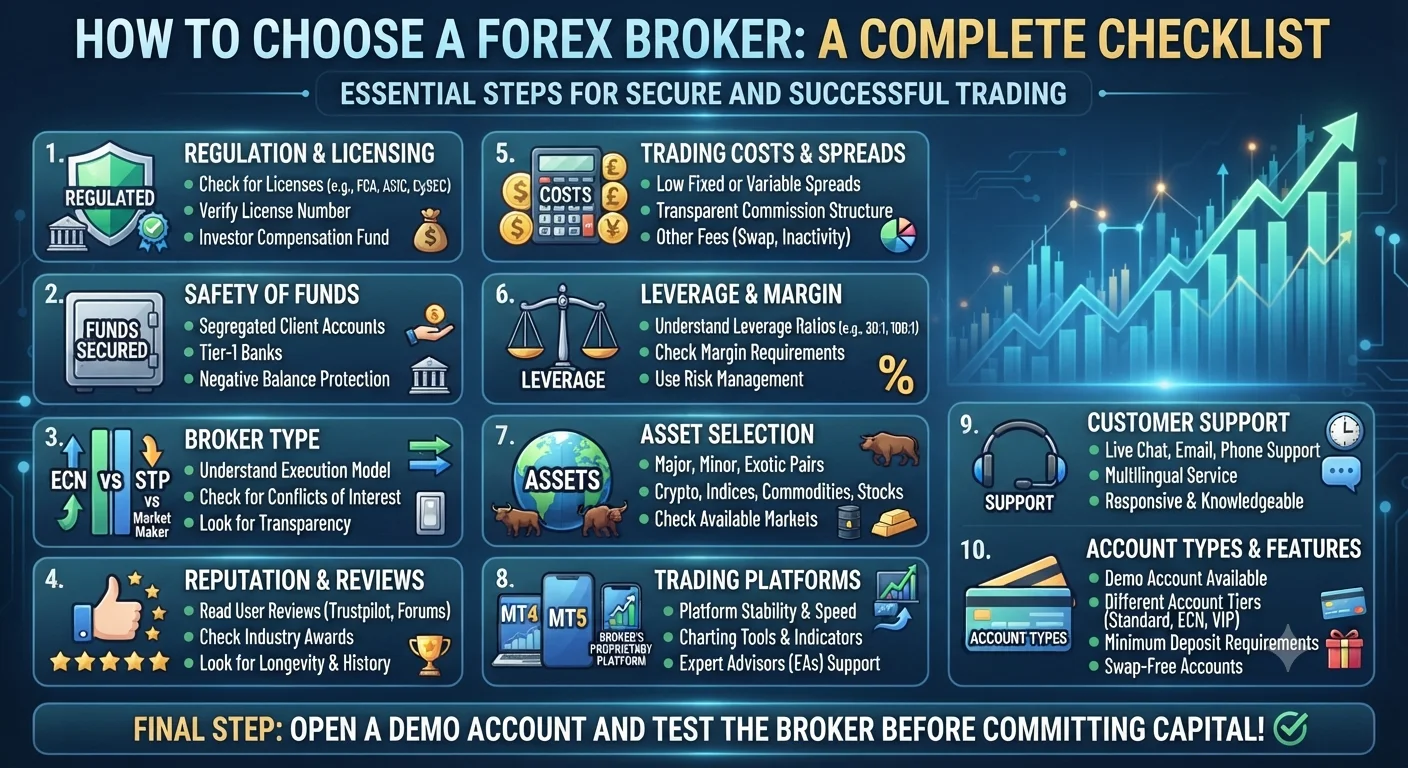
Choosing the right forex broker is one of the most important decisions a trader makes. The broker you choose determines the safety of your funds, the quality of your trade execution, the cost of every trade you place and the platform tools available to you. This checklist covers every factor that matters.
Why Choosing a Forex Broker Matters
Many beginners focus entirely on finding a trading strategy before they have even chosen a proper broker. This is the wrong order of priorities.
Your broker sits between you and the market. Every single trade you place passes through them. If the broker is poorly regulated your funds are at risk regardless of how good your strategy is. If the spreads are too wide your strategy may be profitable in theory but unprofitable in practice. If the platform is unreliable your orders may not execute when you need them to.
Getting the broker decision right first protects everything that comes after it.
The Complete Broker Selection Checklist
- Why Choosing a Forex Broker Matters
- The Complete Broker Selection Checklist
- 1. Regulation and Licensing
- 2. Segregated Client Funds
- 3. Negative Balance Protection
- 4. Spreads and Commissions
- 5. Trading Platform Quality
- 6. Available Currency Pairs and Instruments
- 7. Leverage Options
- 8. Deposit and Withdrawal Process
- 9. Customer Support Quality
- 10. Demo Account Availability
- Mistakes and Red Flags to Avoid
- Frequently Asked Questions
- Q: What is the most important thing to check when choosing a forex broker?
- Q: Is a broker with a very low minimum deposit trustworthy?
- Q: What is the difference between an ECN broker and a market maker?
- Q: Can I use multiple brokers?
- Q: How do I verify a broker's regulation?
1. Regulation and Licensing
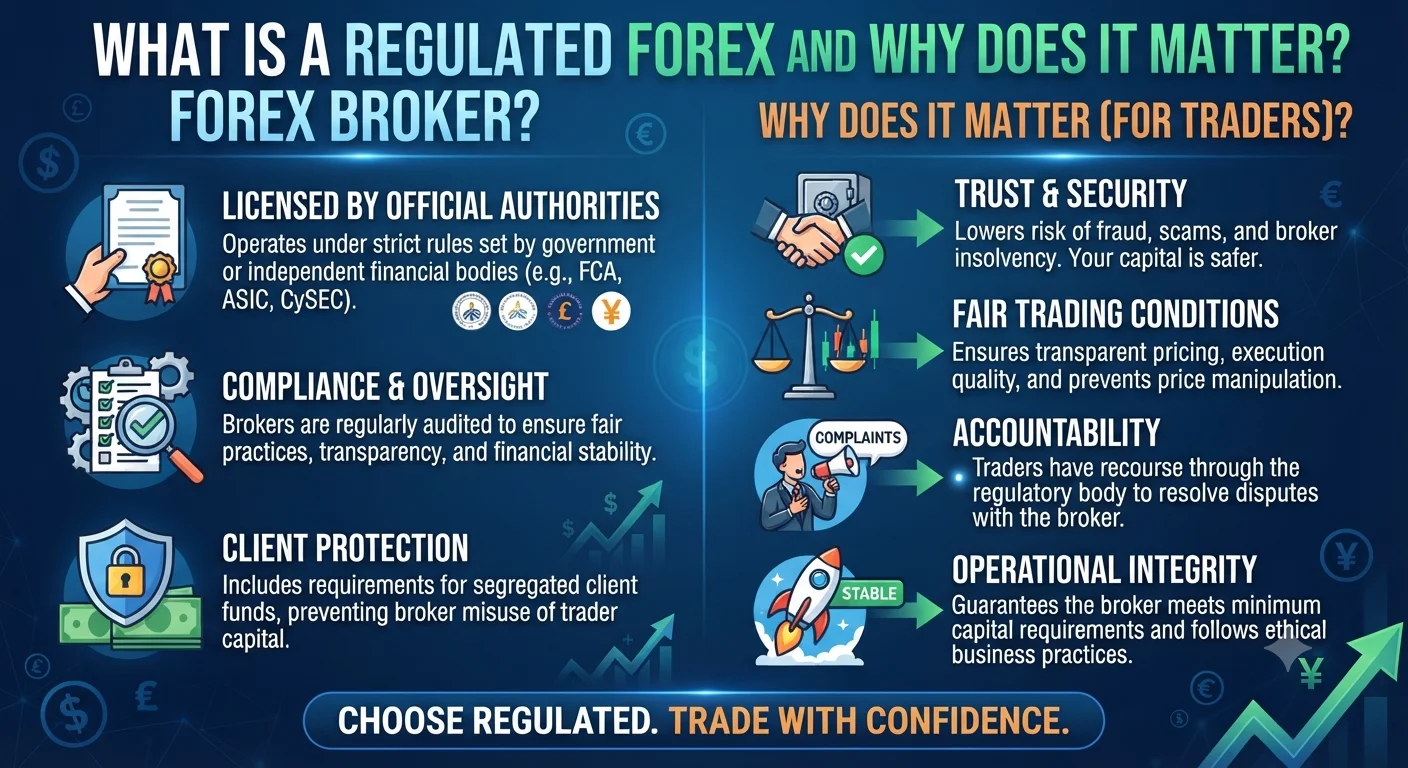
This is the single most important factor. A regulated broker is required by law to follow strict rules about how client funds are handled, how trades are executed and how disputes are resolved.
The most respected regulatory bodies in the world include:
| Regulatory Body | Country | Known As |
|---|---|---|
| Financial Conduct Authority | United Kingdom | FCA |
| Australian Securities and Investments Commission | Australia | ASIC |
| Cyprus Securities and Exchange Commission | Cyprus / EU | CySEC |
| Commodity Futures Trading Commission | United States | CFTC |
| Financial Sector Conduct Authority | South Africa | FSCA |
| Dubai Financial Services Authority | UAE | DFSA |
What to do: Go to the regulator's official website and search for the broker by name or license number. Do not rely solely on what the broker's own website claims.
Key point: A broker regulated in an offshore jurisdiction with no meaningful oversight is not the same as one regulated by the FCA or ASIC. Offshore regulation often provides little to no real protection for retail traders.
2. Segregated Client Funds
A properly regulated broker is required to keep your deposited funds in a segregated account that is completely separate from the broker's own operating funds. This means that if the broker goes bankrupt your money cannot be used to pay their debts.
Always confirm that a broker uses segregated client accounts before depositing any funds. This information is typically stated in the broker's regulatory disclosures or terms and conditions.
3. Negative Balance Protection
Negative balance protection means the broker guarantees that you can never lose more than your deposited balance. Without it extreme market volatility could theoretically cause your account to go into a negative balance leaving you owing money to the broker.
In the European Union and UK this protection is mandatory for retail traders under ESMA and FCA rules. Traders in other regions should check explicitly whether their broker offers it.
4. Spreads and Commissions
Every trade has a cost. Understanding exactly what you pay per trade is essential for evaluating whether a broker's fee structure suits your trading style.
| Fee Type | How It Works | Best For |
|---|---|---|
| Spread only | Profit built into the bid/ask difference | Casual and swing traders |
| Commission + raw spread | Flat fee per lot plus very tight raw spread | Active and high-frequency traders |
| Fixed spread | Spread stays constant regardless of market conditions | Traders who want predictable costs |
Example: If EUR/USD has a 1.5 pip spread on a standard lot trade that spread costs approximately $15. If you place 20 trades per week that is $300 per week in spread costs alone before a single pip of profit is counted.
Always test a broker's live spreads during the trading sessions you plan to trade. Demo account spreads can differ from live account spreads.
5. Trading Platform Quality
The trading platform is your direct interface with the market. It must be stable, fast and fully featured for the type of analysis and trading you intend to do.
MetaTrader 4 (MT4) remains the most widely used retail forex platform in the world. It supports Expert Advisors (EAs) for automated trading and has an enormous library of custom indicators.
MetaTrader 5 (MT5) is the upgraded successor with additional order types, more built-in indicators and better support for multiple asset classes.
Proprietary platforms built by individual brokers vary widely in quality. Some are excellent. Others are limited and lack the tools serious traders need.
Recommended Articles
 BROKER PLATFORM REVIEWS
What to check:
- Is the platform available on desktop, web browser and mobile?
- Does it support automated trading if you plan to use EAs?
- Is the charting functionality sufficient for your analysis style?
- How quickly do orders execute?
6. Available Currency Pairs and Instruments
Confirm the broker offers the specific currency pairs you intend to trade. Most brokers offer all major pairs. Coverage of minor and exotic pairs varies significantly.
If you also plan to trade other instruments such as indices, commodities or metals check whether the broker covers these under a single account.
7. Leverage Options
Leverage amplifies both profits and losses. The maximum leverage available varies by region due to regulatory restrictions:
| Region | Maximum Retail Leverage (Major Pairs) |
|---|---|
| European Union / UK | 30:1 |
| Australia | 30:1 |
| United States | 50:1 |
| Outside regulated regions | Up to 500:1 or higher |
Higher leverage is not better. It means a smaller price move can wipe out your entire account. Choose a broker that allows you to trade at the leverage level appropriate to your risk management rules.
8. Deposit and Withdrawal Process
Research how the broker handles deposits and withdrawals before you put any money in:
- What payment methods are accepted?
- Are there fees on deposits or withdrawals?
- How quickly are withdrawals processed?
- Are there any minimum withdrawal amounts?
Delays or complications in withdrawing your own money are one of the earliest and clearest warning signs of a problematic broker.
9. Customer Support Quality
Test the broker's customer support before opening a live account. Send a question by live chat and by email. Note how quickly they respond, whether the answer is actually helpful and whether support is available during the trading hours you plan to use.
Poor customer support during a technical problem with an open trade can be extremely costly.
10. Demo Account Availability
Any reputable broker offers a free demo account that uses virtual money but real market conditions and live prices. Use the demo account to:
- Test platform stability and execution speed
- Verify that live spreads match what was advertised
- Practice your strategy without risking real money
If a broker does not offer a demo account that is itself a significant red flag.
Mistakes and Red Flags to Avoid
Unregulated or offshore-only brokers: If a broker is only registered in a jurisdiction with no meaningful retail trader protections choose a different one. Your funds have no guarantee.
Guaranteed profit claims: No legitimate broker promises or implies guaranteed returns from trading. Any broker that does is either misleading you or selling an illegal scheme.
Pressure to deposit quickly: Legitimate brokers do not pressure you to deposit funds immediately or offer you "limited time bonuses" that expire in hours.
Withdrawal complaints: Before using any broker search their name plus the word "withdrawal" in online trading forums and reviews. A pattern of withdrawal problems is a serious warning sign.
Bonuses with impossible conditions: Some brokers offer deposit bonuses that come with trading volume requirements so large that it is effectively impossible to withdraw the bonus funds. Read the terms carefully.
No physical address or contact information: A legitimate, regulated broker has a verifiable registered business address and multiple contact methods.
Frequently Asked Questions
Q: What is the most important thing to check when choosing a forex broker?
Regulation is the most important factor. A broker regulated by a reputable authority such as the FCA, ASIC or CySEC is required to follow strict rules about fund protection, fair execution and dispute resolution. Without regulation there is no meaningful protection for your deposited funds.
Q: Is a broker with a very low minimum deposit trustworthy?
The minimum deposit amount alone tells you nothing about trustworthiness. Some highly reputable regulated brokers offer accounts from $0 or $10. The key question is always regulation and fund safety, not the minimum deposit amount.
Q: What is the difference between an ECN broker and a market maker?
An ECN (Electronic Communications Network) broker passes your orders directly to the interbank market or a pool of liquidity providers. You get raw spreads plus a commission. A market maker creates an internal market and takes the other side of your trades. Market makers are not inherently bad but some have a conflict of interest in your trades losing. ECN brokers are generally preferred by active traders who want transparent, direct market access.
Q: Can I use multiple brokers?
Yes. Many experienced traders maintain accounts with more than one regulated broker. This allows comparison of execution quality and spreads and provides a backup if one broker has technical problems.
Q: How do I verify a broker's regulation?
Go directly to the regulatory body's official website and use their public register to search for the broker by name or license number. Do not trust a regulatory logo on the broker's website without verifying it independently on the regulator's own site.