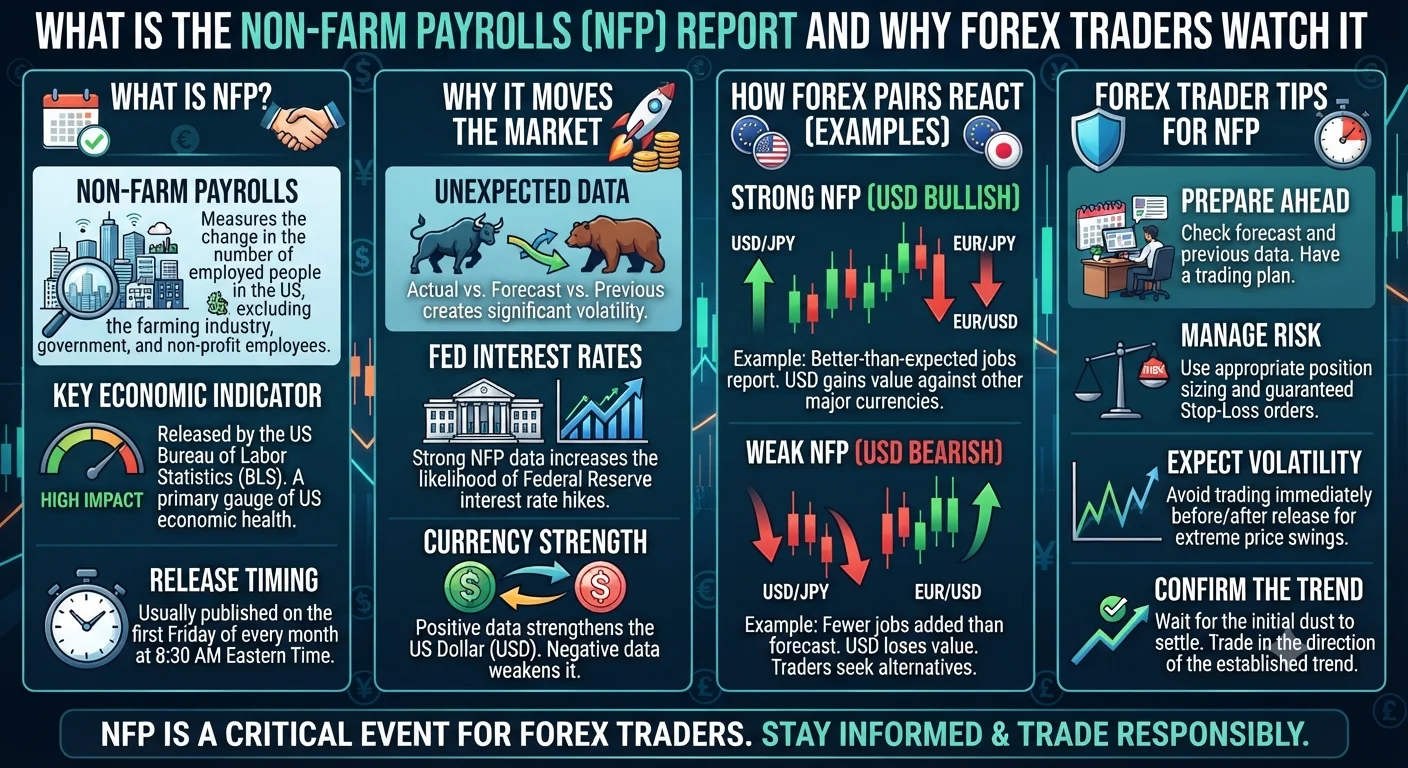
The Non-Farm Payrolls report, commonly called the NFP, is a monthly employment data release from the United States Bureau of Labor Statistics that shows how many jobs were added or lost in the US economy outside of the farming sector. It is one of the most market-moving economic reports in the world. When the NFP is released on the first Friday of every month the US Dollar and most major currency pairs can move 50 to 150 pips or more within minutes.
Quick Answer: The Market Impact of the NFP
The NFP matters to forex traders because employment is one of the two core mandates of the US Federal Reserve. Strong job creation signals a healthy economy and increases the likelihood that the Federal Reserve will maintain or raise interest rates. Higher interest rates typically strengthen the US Dollar.
Weak job creation or a decline in employment signals economic trouble and increases the likelihood that the Federal Reserve will cut rates or keep them lower for longer. This typically weakens the US Dollar.
Because the US Dollar is involved in approximately 88% of all global daily forex transactions a significant surprise in the NFP number moves virtually every major currency pair simultaneously.
What Is the NFP Report? A Simple Definition
- Quick Answer: The Market Impact of the NFP
- What Is the NFP Report? A Simple Definition
- The Mechanism: Why the NFP Affects Currency Prices
- A Real-World Example
- How Traders Can Prepare for NFP Release Days
- Know the date and time in advance
- Watch the consensus forecast
- Decide your approach before the release
- Frequently Asked Questions
- Q: What does non-farm mean in the NFP report?
- Q: When is the NFP released each month?
- Q: Why does the NFP affect currency pairs that do not include the US Dollar?
- Q: Is it safe to trade during the NFP release?
The NFP report is formally called the Employment Situation Summary. It is produced by the US Bureau of Labor Statistics (BLS) and released at 8:30 AM Eastern Time on the first Friday of every month.
The headline figure is the change in non-farm payrolls: the number of new jobs added to the US economy during the previous month excluding farm workers, private household employees and non-profit organisation employees. These categories are excluded because they tend to distort the underlying employment trend.
The report also includes several important secondary figures that traders monitor alongside the headline number:
| Component | What It Shows | Market Importance |
|---|---|---|
| Non-farm payrolls change | Jobs added or lost | Very High |
| Unemployment rate | Percentage of workforce unemployed | Very High |
| Average hourly earnings | Wage growth rate | Very High |
| Labour force participation rate | Percentage of adults working or seeking work | Medium |
| Previous month revision | Adjustment to last month's figure | High |
The average hourly earnings figure has become increasingly important in recent years because wage growth feeds directly into inflation. Rising wages mean more consumer spending which can push prices higher and increase pressure on the Federal Reserve to maintain higher interest rates.
The Mechanism: Why the NFP Affects Currency Prices
The NFP affects the US Dollar through two interconnected channels:
Federal Reserve policy expectations: Strong NFP data reduces the probability that the Fed will cut rates. Traders update their expectations for future Fed decisions based on the data, which immediately shifts demand for the US Dollar.
Risk sentiment: A very strong NFP report suggests the US economy is healthy which tends to reduce global risk aversion. This can strengthen risk-sensitive currencies like the Australian Dollar and weaken traditional safe havens like the Japanese Yen and Swiss Franc simultaneously.
The reaction is always measured against the market consensus forecast published ahead of the release. Dozens of major banks and research firms submit their NFP predictions and these are averaged into a consensus figure. The market prices in this expectation before the release. The actual price movement after the release depends on how far the actual number deviates from that consensus.
Recommended Articles
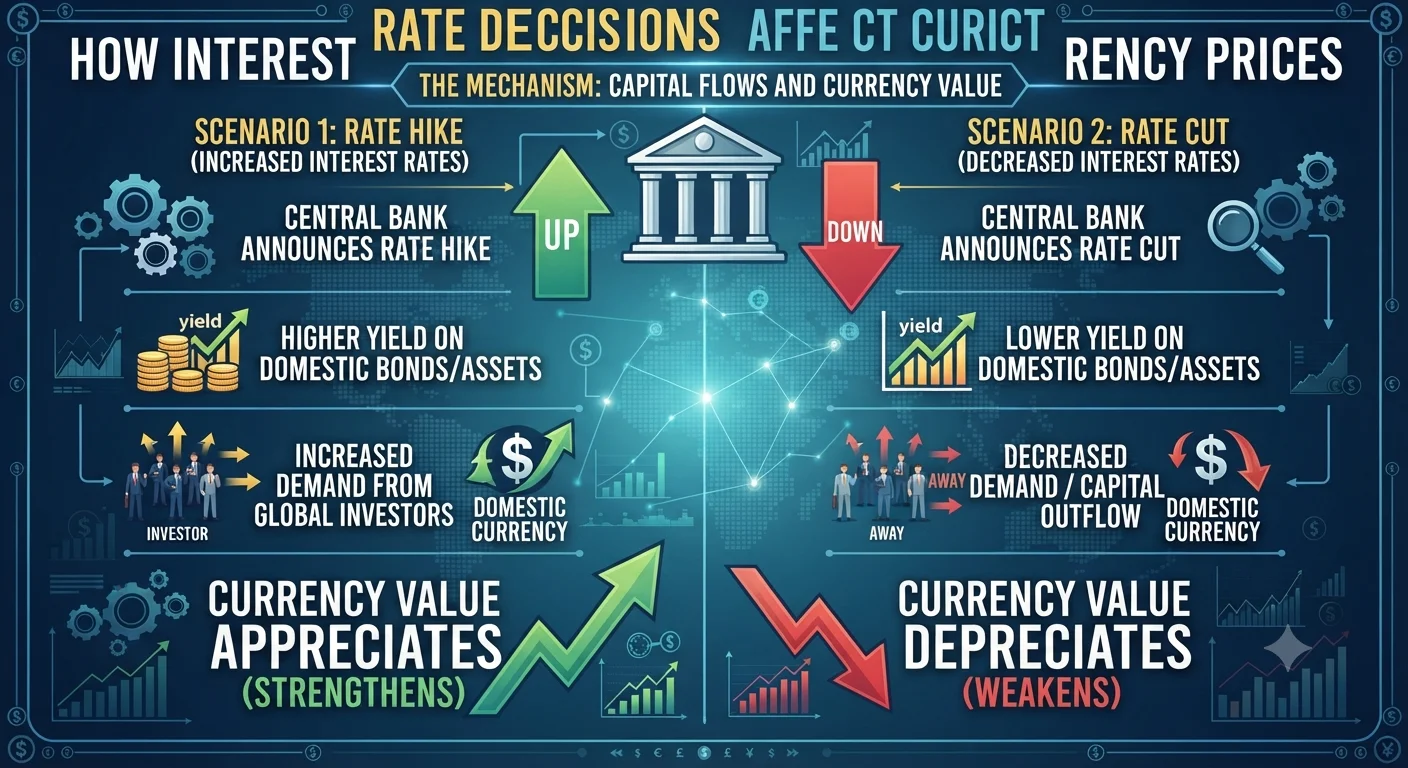 MARKET NEWS ECONOMIC CONCEPTS
| NFP Outcome vs Forecast | Typical US Dollar Reaction |
|---|---|
| Much stronger than expected | USD strengthens sharply |
| Slightly stronger than expected | USD strengthens moderately |
| In line with expectations | Minimal reaction |
| Slightly weaker than expected | USD weakens moderately |
| Much weaker than expected | USD weakens sharply |
A Real-World Example
In November 2023 the NFP report showed 150,000 jobs added against a consensus forecast of 180,000 jobs. The miss of 30,000 jobs below expectations was compounded by a downward revision to the previous month's figure.
EUR/USD rose approximately 80 pips within the first 15 minutes after the release as the US Dollar weakened on reduced expectations for further Federal Reserve rate hikes. GBP/USD moved similarly. USD/JPY fell sharply as traders sold the Dollar against the Yen.
This kind of coordinated movement across multiple major pairs within minutes is typical of a significant NFP surprise.
How Traders Can Prepare for NFP Release Days
Know the date and time in advance
The NFP release date is published months in advance on the US Bureau of Labor Statistics website and is marked as a high-impact event on all major economic calendars. Mark it in your trading calendar at the start of each month.
Watch the consensus forecast
In the week before NFP release major financial news services publish the consensus forecast from surveyed economists. Note this figure. The actual reaction will be driven by the gap between this forecast and the reported number.
Decide your approach before the release
There are three common approaches forex traders use around the NFP:
Close positions before the release: Many experienced traders close all open positions before 8:30 AM ET on NFP Friday to avoid being caught by the volatility. This is the most conservative approach and avoids the risk of a spike triggering a stop-loss before the true direction is established.
Trade the initial reaction: Some traders attempt to trade the immediate directional move after the release. This carries extreme risk because spreads widen dramatically at release time and prices can spike in one direction before reversing within seconds.
Trade the settled trend after the spike: A more measured approach is to wait 15 to 30 minutes after the release for the initial volatility to settle and then trade the direction the market has established. This misses the first large move but avoids the most dangerous conditions.
Frequently Asked Questions
Q: What does non-farm mean in the NFP report?
Non-farm means the report excludes agricultural employment. Farm workers are excluded because agricultural employment is highly seasonal and would create large artificial fluctuations in the monthly jobs figure that do not reflect the true underlying health of the broader economy.
Q: When is the NFP released each month?
The Non-Farm Payrolls report is released at 8:30 AM Eastern Time on the first Friday of every month. It covers employment data from the previous month. The exact release dates for the full year are published by the US Bureau of Labor Statistics on their official website.
Q: Why does the NFP affect currency pairs that do not include the US Dollar?
Because the US Dollar is involved in approximately 88% of all daily forex transactions globally a significant move in the Dollar ripples through to virtually every major currency pair. When USD/JPY moves after NFP for example that move is driven by the Dollar side of the pair not the Yen. EUR/USD, GBP/USD and AUD/USD all typically see significant movement on NFP release regardless of any European, British or Australian data on that day.
Q: Is it safe to trade during the NFP release?
Trading during the immediate NFP release is extremely high risk even for experienced traders. Spreads widen to several times their normal level, prices can spike 30 to 50 pips in both directions within seconds and orders can be filled at significantly worse prices than intended due to slippage. Most risk management guidelines suggest either closing positions before the release or waiting at least 15 minutes afterward for conditions to normalise.