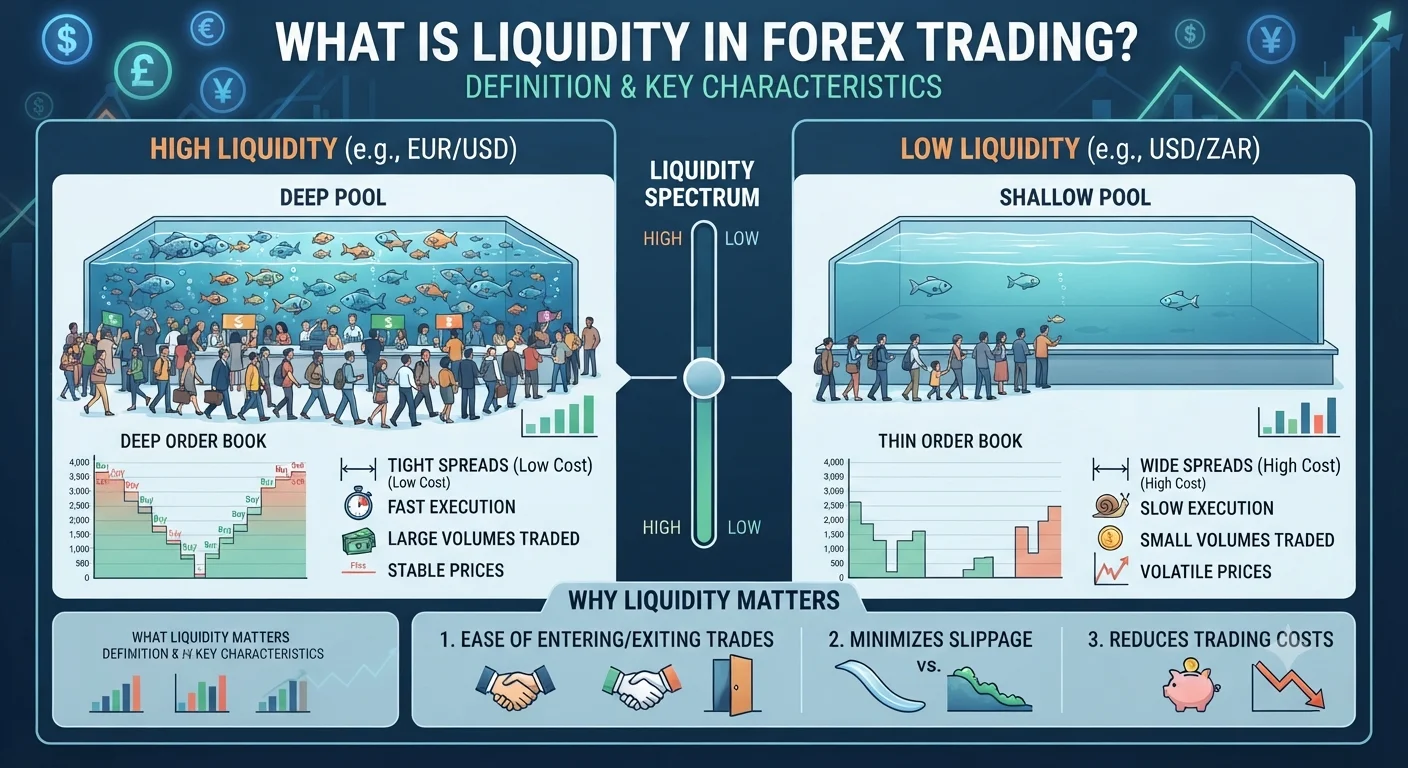
Liquidity in forex trading refers to how easily and quickly a currency pair can be bought or sold at a stable price without causing the price itself to move significantly. A highly liquid market has many buyers and sellers active at any given moment which means orders are filled quickly at prices close to what was quoted. A low-liquidity market has fewer participants which means orders may be filled at worse prices or with greater delays.
Quick Definition: What Is Liquidity?
Liquidity is a measure of market depth and activity. Think of it like a busy marketplace versus a quiet one.
In a busy marketplace with hundreds of buyers and sellers you can sell your goods quickly at the going market price because there is always someone ready to buy. In a quiet marketplace with only a handful of participants you might have to wait a long time to find a buyer or accept a lower price to attract one.
Forex markets are the most liquid financial markets in the world. The Bank for International Settlements (BIS) reports that average daily trading volume in the global forex market exceeds $7.5 trillion. This extraordinary volume means that for the most actively traded currency pairs orders are filled almost instantly at prices that accurately reflect the current market rate.
However liquidity is not equal across all currency pairs or at all times of day. This difference has a direct and measurable impact on your trading costs and execution quality.
How Liquidity Works in Real Forex Trading
- Quick Definition: What Is Liquidity?
- How Liquidity Works in Real Forex Trading
- Liquidity Affects the Spread
- Liquidity Affects Order Execution
- Liquidity Varies by Time of Day
- A Practical Example
- Why Liquidity Matters for Your Trading Results
- Which Currency Pairs Have the Highest Liquidity?
- Frequently Asked Questions
- Q: What does low liquidity mean in forex?
- Q: Which forex pair has the highest liquidity?
- Q: Does liquidity affect automated trading systems?
- Q: Why do forex spreads widen at certain times?
- Q: Is the forex market more liquid than the stock market?
Liquidity Affects the Spread
The spread is the difference between the price at which you can buy a currency pair (the ask price) and the price at which you can sell it (the bid price). The spread is your primary transaction cost on every trade.
In highly liquid markets many competing buyers and sellers narrow the gap between the best available buy price and sell price. This means tighter spreads and lower costs per trade.
In low-liquidity markets fewer participants mean the gap between the best bid and ask widens. This increases your cost per trade and makes it harder to profit from smaller price movements.
Example comparison:
| Currency Pair | Liquidity Level | Typical Spread |
|---|---|---|
| EUR/USD | Extremely high | 0.5 to 1.5 pips |
| GBP/USD | Very high | 1 to 2 pips |
| USD/JPY | Very high | 0.5 to 1.5 pips |
| EUR/GBP | High | 1 to 2 pips |
| USD/TRY | Low | 10 to 30 pips |
| USD/ZAR | Low | 20 to 50 pips |
The difference in spread between EUR/USD and an exotic pair like USD/ZAR is enormous. A trader placing 20 standard lot trades per month on USD/ZAR could pay hundreds of dollars more in spread costs than a trader making the same trades on EUR/USD.
Liquidity Affects Order Execution
In a liquid market your trade order is matched almost instantaneously against an existing counterparty order. The price you see when you click buy is very close to the price at which your order actually fills.
In a low-liquidity market there may not be an immediate counterparty available at your desired price. The broker or system must search for a matching order which takes longer and may result in slippage — your order fills at a price worse than the one you intended.
Key Term: Slippage is when your order fills at a different (usually worse) price than the price you saw when you placed the order. It occurs most commonly in low-liquidity conditions or during high-impact news events when market conditions change faster than orders can be matched.
Liquidity Varies by Time of Day
Even the most liquid currency pairs experience significant changes in liquidity throughout the 24-hour trading day depending on which markets are open.
| Time Period (GMT) | Market Activity | Liquidity Level |
|---|---|---|
| 10 PM to 12 AM | Sydney open, quiet period | Low |
| 12 AM to 8 AM | Tokyo session | Moderate (higher for JPY pairs) |
| 8 AM to 1 PM | London session | High |
| 1 PM to 5 PM | London and New York overlap | Very High (peak liquidity) |
| 5 PM to 10 PM | New York only, then quiet | Moderate then Low |
The London and New York overlap from 1 PM to 5 PM GMT is consistently the most liquid period of the trading day across the major currency pairs. Spreads are at their tightest and large orders can be executed with minimal impact on the price.
Trading during low-liquidity periods such as late Sunday evenings or during major public holidays carries meaningfully higher spread costs and greater slippage risk.
Recommended Articles
 FOREX GLOSSARY TERMINOLOGY
A Practical Example
A trader wants to buy 5 standard lots of EUR/USD. EUR/USD is the most liquid currency pair in the world.
Because the market has an enormous number of active buyers and sellers at any given moment during the London or New York sessions the broker can fill this order almost instantly at a spread of approximately 1 pip. The total spread cost on 5 standard lots at $10 per pip is $50.
Now consider the same trader buying 5 standard lots of an exotic pair like USD/NGN (US Dollar vs Nigerian Naira). This pair has very low liquidity in the retail forex market. Finding counterparties for this size of order may take longer and the spread may be 50 pips or more. The same trade would cost $2,500 in spread alone — fifty times the cost of the EUR/USD trade.
For most retail traders this makes exotic pairs genuinely difficult to trade profitably even with a sound strategy.
Why Liquidity Matters for Your Trading Results
Liquidity is not just an abstract concept. It has concrete, measurable effects on your bottom line:
Lower transaction costs: High-liquidity pairs have tighter spreads meaning you pay less to enter and exit every trade. Over hundreds of trades per year this difference is substantial.
Better execution: Your orders fill closer to your intended price in liquid markets. In low-liquidity conditions you may consistently get worse entry prices than planned which erodes profitability.
Easier risk management: In a liquid market your stop-loss order executes very close to the level you set. In a low-liquidity market your stop may slip significantly past the intended level during a fast move resulting in a larger loss than planned.
Tighter price discovery: In liquid markets prices reflect true market consensus at all times. In illiquid markets prices can gap suddenly or behave erratically even without any fundamental reason.
Scalability: Liquid markets can absorb large orders without significantly moving the price. This matters less for small retail traders but becomes important as account sizes grow.
Which Currency Pairs Have the Highest Liquidity?
The major pairs involving the US Dollar are the most liquid in the market:
| Rank | Currency Pair | Approximate Daily Volume Share |
|---|---|---|
| 1 | EUR/USD | ~22% of all daily forex volume |
| 2 | USD/JPY | ~13% |
| 3 | GBP/USD | ~9% |
| 4 | USD/CNY | ~7% |
| 5 | USD/CAD | ~6% |
| 6 | AUD/USD | ~5% |
These six pairs alone account for more than 60% of all daily forex trading volume globally. For most retail traders who need tight spreads and reliable execution these pairs are the most practical and cost-effective choices.
Frequently Asked Questions
Q: What does low liquidity mean in forex?
Low liquidity in forex means there are fewer buyers and sellers active in the market for a particular currency pair or at a particular time. Low liquidity results in wider spreads, slower order execution, higher risk of slippage and more erratic price behaviour. It typically occurs in exotic currency pairs, during off-peak trading hours and around major public holidays.
Q: Which forex pair has the highest liquidity?
EUR/USD is consistently the most liquid currency pair in the world, accounting for approximately 22% of all global daily forex trading volume according to BIS data. It has the tightest typical spreads and the most reliable execution of any retail forex instrument.
Q: Does liquidity affect automated trading systems?
Yes significantly. Automated trading systems (Expert Advisors) that perform well in backtesting on highly liquid pairs such as EUR/USD may produce very different results when applied to exotic or lower-liquidity pairs. Slippage and wider spreads in low-liquidity environments can turn a theoretically profitable strategy into a losing one in live trading.
Q: Why do forex spreads widen at certain times?
Spreads widen when market liquidity decreases. This happens at the open of the Sydney session on Sunday evenings, during the quiet period between the New York close and the Sydney open, and during major public holidays when large institutional participants are not active. Spreads also widen sharply immediately before and after high-impact economic announcements as market makers temporarily pull back their quotes.
Q: Is the forex market more liquid than the stock market?
Yes. The global forex market with over $7.5 trillion in average daily volume is significantly more liquid than any stock exchange. The New York Stock Exchange has an average daily trading volume of approximately $20 to $25 billion which is a fraction of the forex market's daily activity. This greater liquidity in forex generally results in tighter bid-ask spreads and easier order execution for large positions.