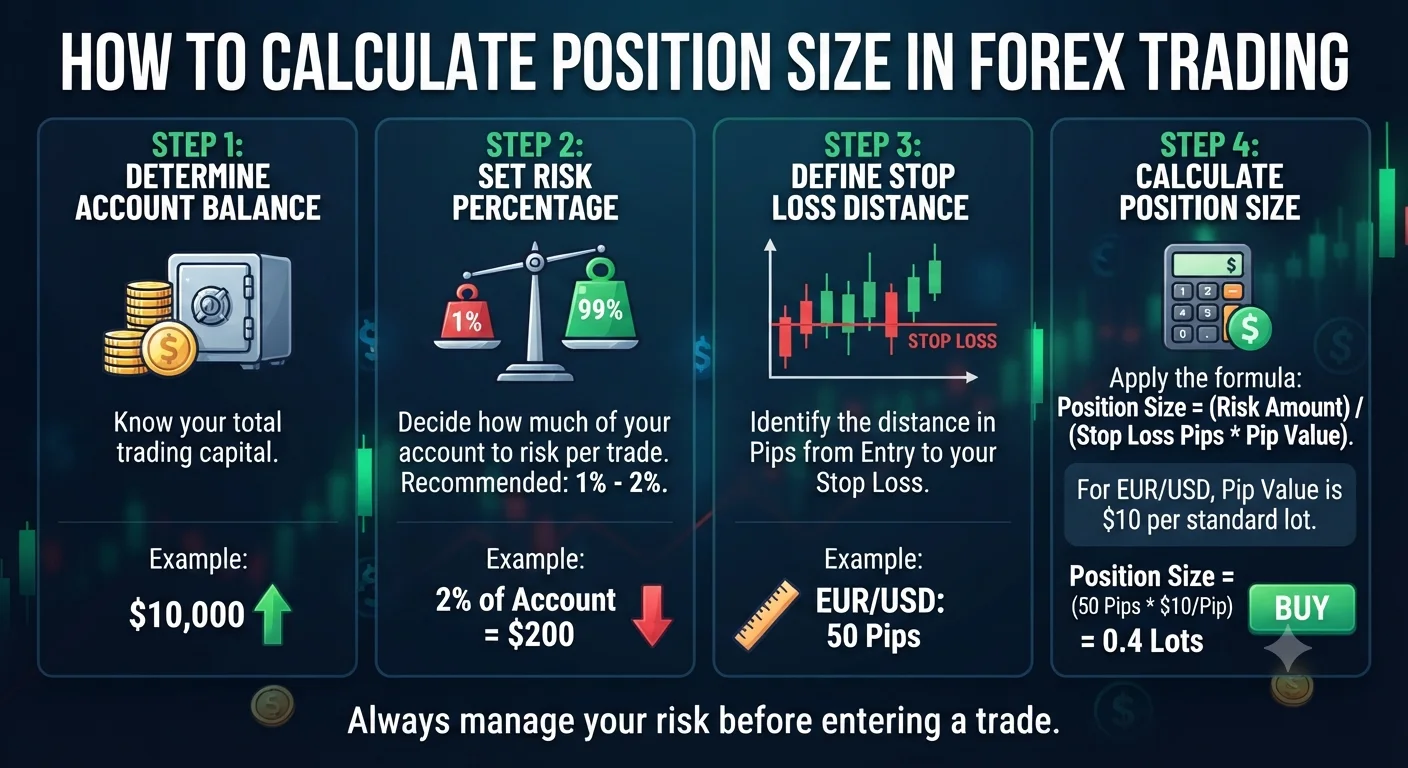
Position sizing is the calculation that determines exactly how many lots to trade on any given setup so that if the trade hits your stop-loss you lose only a predetermined percentage of your account. It is the most practical application of risk management in forex trading. Without it even a sound strategy will produce losses far larger than intended.
What Is Position Sizing and Why It Matters
Most beginner traders pick their position size by feel. They trade a standard lot because it sounds like the right amount or they trade whatever the broker defaults to when they open the order window. This is one of the most common and most costly mistakes in retail forex.
Position sizing done correctly works the other way around. You start with the amount you are willing to lose if the trade goes wrong and then calculate the position size that produces exactly that loss if your stop-loss is hit. The trade setup determines the stop-loss distance and the stop-loss distance combined with your risk tolerance determines your position size.
This approach means your risk per trade is always controlled and always consistent regardless of how wide or tight the stop-loss needs to be on any particular setup.
Step-by-Step Process
- What Is Position Sizing and Why It Matters
- Step-by-Step Process
- Step 1: Decide Your Risk Percentage Per Trade
- Step 2: Identify Your Stop-Loss Distance in Pips
- Step 3: Calculate the Pip Value
- Step 4: Apply the Formula
- Practical Examples Across Different Account Sizes
- Tools That Do the Calculation for You
- How Position Sizing Protects You During Losing Streaks
- Common Mistakes to Avoid
- Frequently Asked Questions
- Q: What is the best position size for a beginner forex trader?
- Q: Should I always use the 1% rule?
- Q: What happens to position size if my account grows?
- Q: Can I use a position size calculator on mobile?
Step 1: Decide Your Risk Percentage Per Trade
Before calculating anything you need a fixed rule for how much of your account you are willing to risk on a single trade. The most widely recommended guideline among professional traders is the 1% rule: never risk more than 1% of your total account balance on any single trade.
Some traders use 0.5% for added conservatism. Some experienced traders with well-tested strategies use up to 2%. Beginners should start at 1% or below until they have consistent experience.
Your maximum risk in currency:
| Account Balance | 0.5% Risk | 1% Risk | 2% Risk |
|---|---|---|---|
| $500 | $2.50 | $5.00 | $10.00 |
| $1,000 | $5.00 | $10.00 | $20.00 |
| $5,000 | $25.00 | $50.00 | $100.00 |
| $10,000 | $50.00 | $100.00 | $200.00 |
Step 2: Identify Your Stop-Loss Distance in Pips
Your stop-loss should be placed at the level where your trade idea is proven wrong based on your technical analysis. This might be below a support level, above a resistance level or beyond a recent swing high or low.
Once you have identified that level measure the distance in pips from your intended entry price to your stop-loss level.
Example: You plan to buy EUR/USD at 1.0850 and place your stop-loss at 1.0810. The distance is 40 pips.
Step 3: Calculate the Pip Value
Pip value varies by currency pair and position size. For USD-quoted pairs (pairs where USD is the quote currency such as EUR/USD and GBP/USD) the pip value per standard lot is approximately $10, per mini lot approximately $1 and per micro lot approximately $0.10.
For other pairs pip value differs and a pip value calculator handles this automatically.
Step 4: Apply the Formula
Position Size = Account Risk Amount divided by (Stop-Loss in Pips multiplied by Pip Value per Lot)
Full worked example:
- Account balance: $3,000
- Risk per trade: 1% equals $30
- Currency pair: EUR/USD
- Entry: 1.0850
- Stop-loss: 1.0810 (40 pips away)
- Pip value per mini lot: $1.00
Position Size = $30 divided by (40 pips multiplied by $1.00) = 0.75 mini lots
Since most brokers allow trading in increments of 0.01 lots you would round down to 0.07 standard lots or trade 7 micro lots to keep the risk within your $30 limit.
If the trade hits the stop-loss the account loses $28 which is just under 1% of the $3,000 balance. If the trade hits a take-profit set at 80 pips away the account gains $56.
Practical Examples Across Different Account Sizes
| Account | Risk % | Risk Amount | Pair | Stop-Loss | Position Size |
|---|---|---|---|---|---|
| $1,000 | 1% | $10 | EUR/USD | 50 pips | 0.02 lots |
| $2,000 | 1% | $20 | GBP/USD | 40 pips | 0.05 lots |
| $5,000 | 1% | $50 | USD/JPY | 30 pips | 0.17 lots |
| $10,000 | 1% | $100 | EUR/USD | 25 pips | 0.40 lots |
These numbers show an important reality: proper position sizing on a small account means trading very small lot sizes. This is correct. Small lot sizes on small accounts are not a limitation. They are the right approach. As the account grows through consistent trading the position sizes grow proportionally and automatically.
Recommended Articles
 RISK MANAGEMENT TRADING PSYCHOLOGY
 RISK MANAGEMENT TRADING PSYCHOLOGY
Tools That Do the Calculation for You
You do not need to do this calculation manually on every trade. Several free tools handle it instantly:
Broker platform calculators: Most MetaTrader 4 and MetaTrader 5 brokers include a built-in position size calculator or trade calculator within the platform.
Myfxbook position size calculator: A free online tool where you enter your account balance, risk percentage, currency pair, stop-loss distance and account currency and it returns the exact lot size.
Babypips position size calculator: Another widely used free online tool that supports all major and minor currency pairs.
EA or indicator-based calculators: In MetaTrader you can install a free position size calculator indicator that overlays directly on your chart and calculates the correct lot size as you drag your stop-loss level.
Using one of these tools removes the possibility of calculation errors and makes the process fast enough that it adds no meaningful delay to your trade entry process.
How Position Sizing Protects You During Losing Streaks
Every trading strategy produces losing streaks. Even a strategy with a 60% win rate will experience runs of five or six consecutive losing trades over a large sample size. Position sizing is what keeps losing streaks survivable.
Comparison over a 10-trade losing streak:
| Risk Per Trade | Starting Balance | After 10 Losses | Account Remaining |
|---|---|---|---|
| 1% | $5,000 | $4,521 | 90.4% |
| 5% | $5,000 | $2,986 | 59.7% |
| 10% | $5,000 | $1,743 | 34.9% |
| 20% | $5,000 | $537 | 10.7% |
At 1% risk per trade a 10-trade losing streak reduces the account by under 10%. At 20% risk per trade the same losing streak is almost fatal to the account. The strategy may be sound but the position sizing made recovery impossible.
Common Mistakes to Avoid
Increasing position size after losses: The instinct to trade bigger after a losing trade to recover quickly is called revenge trading. It breaks the position sizing discipline at exactly the moment when the account is most vulnerable.
Using a fixed lot size regardless of stop-loss distance: Trading 0.10 lots on every trade regardless of whether the stop-loss is 15 pips or 80 pips away means your actual risk varies enormously between trades. Risk becomes inconsistent and uncontrolled.
Ignoring pip value differences between pairs: A 50-pip stop-loss on EUR/USD at a given lot size produces a different dollar loss than a 50-pip stop-loss on USD/JPY at the same lot size. Always account for the pip value of the specific pair you are trading.
Treating position sizing as optional for small accounts: Small accounts need position sizing discipline more than large accounts because a single oversized loss represents a much larger percentage of a smaller account balance.
Frequently Asked Questions
Q: What is the best position size for a beginner forex trader?
Beginners should start with micro lots (0.01 lots) and apply the 1% risk rule strictly regardless of how confident they feel about any particular trade. This keeps losses small while real trading experience is being built and allows the trader to survive the inevitable early mistakes without destroying their account.
Q: Should I always use the 1% rule?
The 1% rule is a guideline not an absolute law. Some experienced traders with well-tested strategies and high win rates use 2%. Some very conservative traders prefer 0.5%. The key principle is that your risk per trade is always fixed and predetermined rather than chosen impulsively based on how you feel about a particular setup.
Q: What happens to position size if my account grows?
If you use a percentage-based risk rule your position size grows automatically as your account grows. A 1% risk on a $5,000 account is $50. A 1% risk on a $10,000 account is $100. The lot size doubles as the account doubles. This means your profits compound naturally as your account grows without you needing to manually adjust your risk rules.
Q: Can I use a position size calculator on mobile?
Yes. Most broker apps include a trade calculator. Myfxbook and Babypips both have mobile-accessible versions of their position size calculators. Several free MetaTrader indicator tools also display the correct lot size directly on your chart.