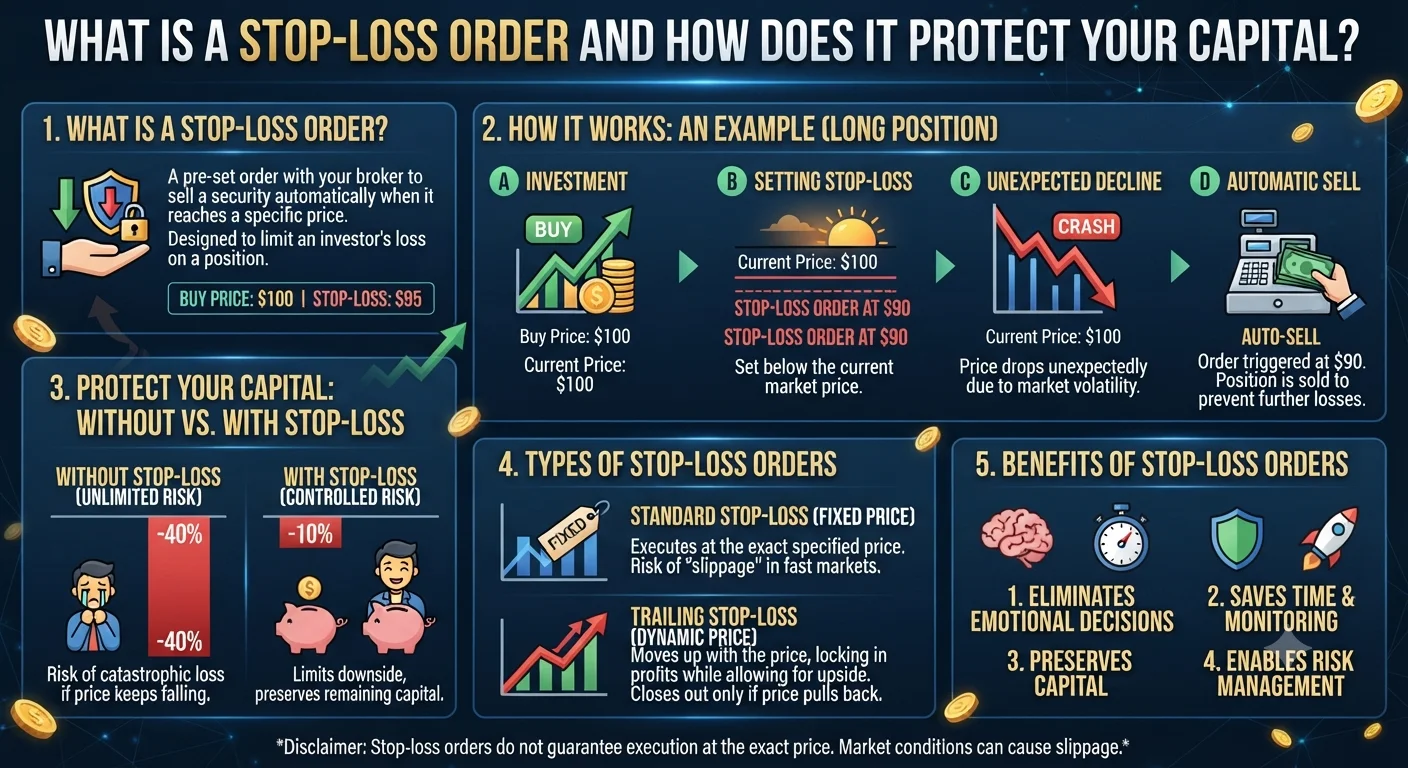
A stop-loss order is an instruction to your forex broker to automatically close an open trade at a specific price if the market moves against you. It defines the maximum amount you are willing to lose on that trade before the position is closed. Once set the stop-loss executes automatically without any action required from you, preventing a small planned loss from becoming a large unplanned one.
Quick Definition: What Is a Stop-Loss Order?
When you open a forex trade you are exposed to market risk from the moment the order fills. The price can move in your favour, generating profit, or it can move against you, generating a loss. Without a stop-loss there is no automatic mechanism to limit how large that loss becomes if the market continues moving against you.
A stop-loss order solves this. You set a specific price at which the trade will close if the market reaches it. If the market never reaches that level the stop-loss does nothing. If the market moves against you to that price the trade closes automatically and the loss is capped at the amount you planned for.
This is not a complicated concept but it is one that many beginning traders skip, either because they believe a trade will always recover or because they feel certain about a particular setup. Both of these are emotional responses that override rational risk management. The market does not care about certainty or conviction.
How It Works in Real Forex Trading
- Quick Definition: What Is a Stop-Loss Order?
- How It Works in Real Forex Trading
- A Practical Example with Position Sizing
- Where to Place a Stop-Loss
- Why It Matters for Your Trading Results
- Frequently Asked Questions
- Q: What happens if the price gaps past my stop-loss?
- Q: Should I move my stop-loss further away if the price is approaching it?
- Q: What is a trailing stop-loss?
- Q: Is it possible to trade forex without a stop-loss?
Example trade:
A trader buys EUR/USD at 1.0850. They believe the price will rise to 1.0950 based on their analysis. However they acknowledge they could be wrong and decide they are willing to lose a maximum of 40 pips on this trade if the market moves against them.
They set a stop-loss at 1.0810 which is 40 pips below their entry.
Three possible outcomes:
| Scenario | Price Reaches | Result |
|---|---|---|
| Trade works as expected | 1.0950 (take-profit) | +100 pips profit |
| Trade moves against them | 1.0810 (stop-loss) | -40 pips loss, trade closes automatically |
| Trade reaches neither level | Between 1.0810 and 1.0950 | Trade remains open |
In scenario two the stop-loss executes automatically. The trader does not need to be watching the screen. The loss is exactly what they planned for before entering the trade.
- How to Calculate Position Size in Forex Trading
- What Is Risk Management in Forex Trading and Why It Matters
Without the stop-loss in scenario two the price might continue falling to 1.0750, 1.0700 or further, turning a 40-pip planned loss into a 100, 150 or larger pip loss that the trader did not intend and may not have the account balance to sustain.
A Practical Example with Position Sizing
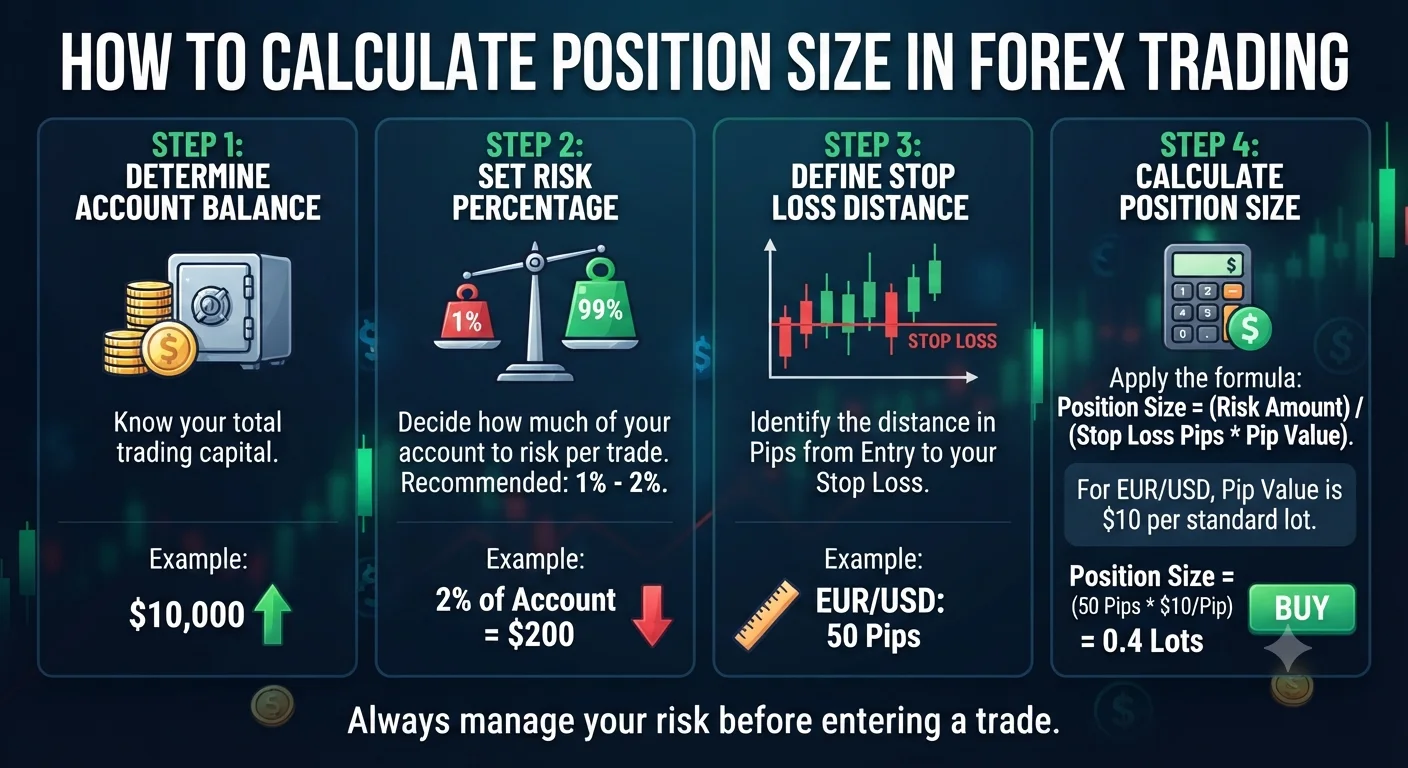
A trader has a $2,000 account and uses the 1% risk rule meaning they risk a maximum of $20 per trade.
They set up a buy trade on GBP/USD with a stop-loss 50 pips below their entry. At the correct position size (0.04 lots where each pip is worth $0.40) a 50-pip stop-loss equals exactly $20 of risk.
If the stop-loss is hit the trader loses $20 which is 1% of their account. Their account balance falls to $1,980. They can take another trade tomorrow with the same disciplined approach.
Without the stop-loss the same trade continuing to move against them by 200 pips would generate an $80 loss, which is 4% of account. Across multiple trades without stop-losses these losses accumulate rapidly and can destroy an account within days.
Where to Place a Stop-Loss
The most important rule: the stop-loss must be placed at the level where your trade idea is proven wrong, not at an arbitrary pip distance from the entry.
Recommended Articles
 RISK MANAGEMENT TRADING PSYCHOLOGY
 RISK MANAGEMENT TRADING PSYCHOLOGY
Common stop-loss placement approaches:
Below support for buy trades: If you buy because the price has reached a support level place the stop-loss below that support level. If the price breaks below support your reason for buying no longer exists.
Above resistance for sell trades: If you sell because the price has reached a resistance level place the stop-loss above that resistance level. If the price breaks above resistance your reason for selling no longer exists.
Beyond recent swing highs or lows: In trend trading a common approach is to place the stop-loss just beyond the most recent swing low (for buy trades) or swing high (for sell trades). A price move beyond that swing point signals that the trend structure has changed.
ATR-based placement: Set the stop-loss at 1 to 1.5 times the Average True Range (ATR) of the pair beyond the entry. This ensures the stop is placed beyond normal daily price noise.
Why It Matters for Your Trading Results
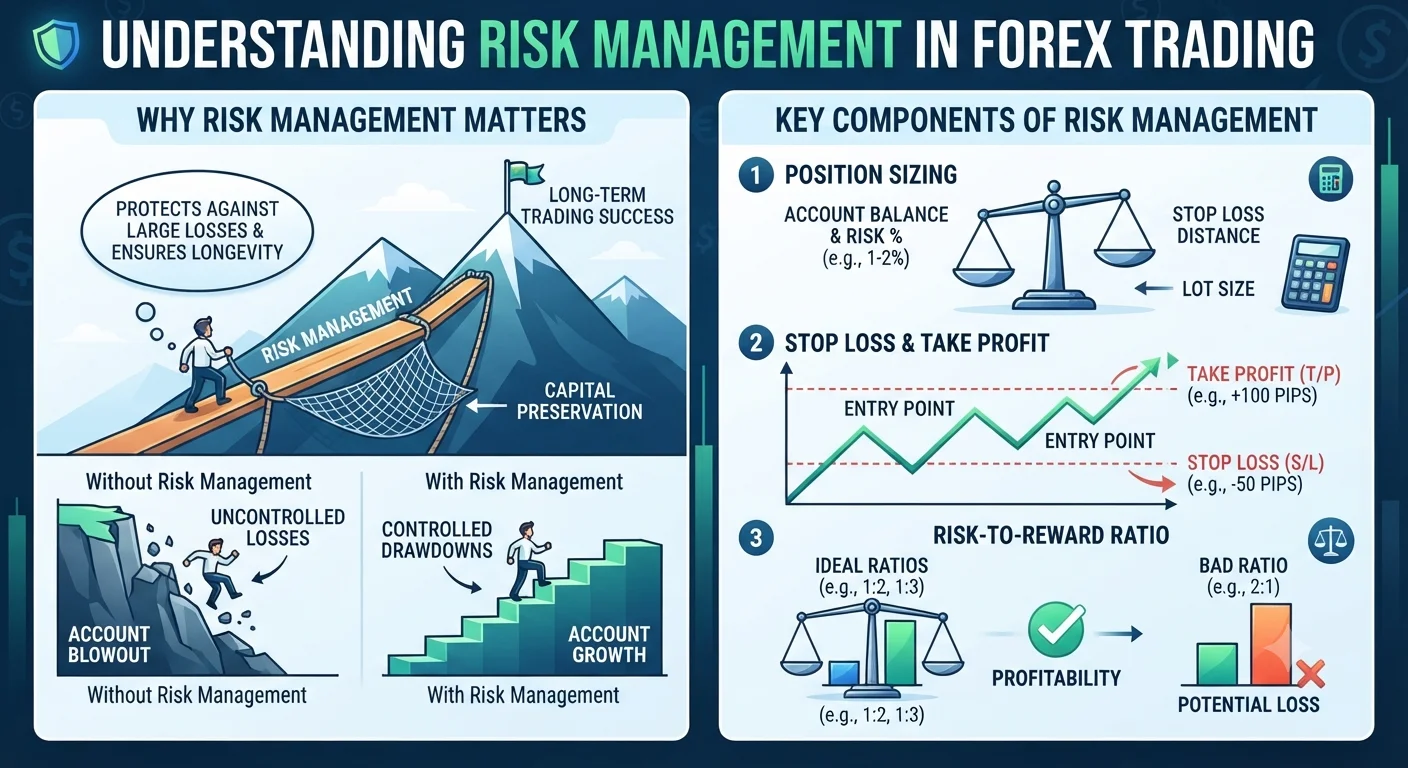
Survivability: A stop-loss on every trade ensures that no single trade can cause catastrophic damage to your account. This keeps you in the market long enough for your strategy to demonstrate its edge over many trades.
Psychological freedom: Knowing your exact maximum loss before you enter a trade removes the anxiety of watching an open position move against you. You have already accepted the potential loss. This makes it far easier to let the trade develop without emotional interference.
Removes the hope trap: Traders without stop-losses often find themselves holding losing trades for hours, days or weeks hoping the price will return to their entry. This psychological trap is called the hope trap and it consistently turns small manageable losses into large account-damaging ones.
Enables proper position sizing: Position sizing depends on knowing the stop-loss distance before the trade is placed. Without a pre-defined stop-loss, position sizing is guesswork.
Frequently Asked Questions
Q: What happens if the price gaps past my stop-loss?
In normal market conditions a stop-loss order executes when the price reaches the specified level. However in situations of extreme volatility such as immediately after a major news release, market open gaps on Sunday evenings or during a major geopolitical event the price may gap past your stop-loss level. In this case the order typically executes at the next available price which may be worse than your stop-loss level. This is called slippage. It is one reason why many experienced traders avoid holding positions open through high-impact news events.
Q: Should I move my stop-loss further away if the price is approaching it?
No. Moving a stop-loss further away from the entry is one of the most destructive habits in retail forex trading. It breaks the risk management discipline you set before entering the trade and exposes the account to a larger loss than originally planned. The stop-loss was placed at the level where the trade idea is wrong. If the price is approaching that level the market is telling you the trade idea may indeed be wrong. Accept the loss and protect the remaining capital.
Q: What is a trailing stop-loss?
A trailing stop-loss is a dynamic stop that automatically moves in the direction of profit as the trade progresses but never moves against the trader. If a trade moves 30 pips in profit and a 20-pip trailing stop is set, the stop-loss moves up to 10 pips below the current price and continues adjusting upward as the trade profits further. This allows the trade to run in favour while locking in an increasing amount of profit as the price advances.
Q: Is it possible to trade forex without a stop-loss?
It is technically possible to trade without a stop-loss but it is not advisable. Every professional risk management framework in retail forex requires a pre-defined maximum loss on every trade. Trading without a stop-loss leaves the account exposed to unlimited losses on any individual trade and increases the probability of account destruction significantly over time.