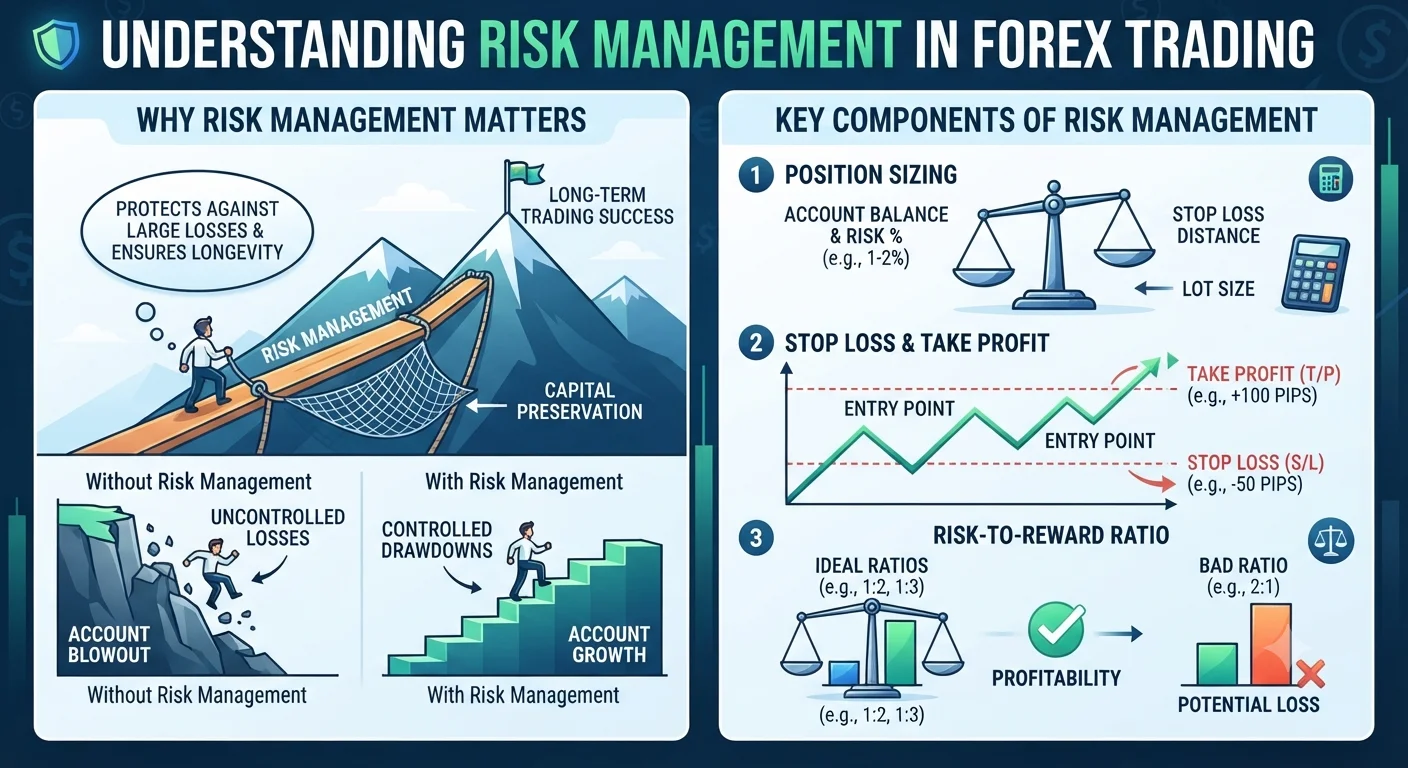
Risk management in forex trading is the set of rules and techniques a trader uses to limit how much money they can lose on any single trade — and across their entire account. It includes deciding how large each position should be, where to place a stop-loss order, and how much of the account to risk at any one time. Without risk management, even a profitable trading strategy will eventually destroy an account.
Quick Definition: What Is Risk Management?
In any business or investment activity, risk management means identifying potential losses before they happen and taking deliberate steps to limit them.
In forex trading, risk management is not optional it is the foundation on which every other trading skill sits.
Even the best trading strategy in the world produces losing trades. Markets are uncertain. No technical indicator, no chart pattern, and no economic analysis can predict price movements with 100% accuracy. Risk management does not stop you from having losing trades. What it does is ensure your losing trades are small enough that your account survives until your winning trades arrive.
💡 Key Principle: Professional traders focus on controlling losses — not on maximising individual profits. A trader who never risks more than 1–2% of their account per trade can survive a long losing streak and still recover. A trader who risks 20–30% per trade can win their first few trades and then lose everything on one bad one.
How Risk Management Works in Real Forex Trading
- Quick Definition: What Is Risk Management?
- How Risk Management Works in Real Forex Trading
- Pillar 1 — Position Sizing
- Pillar 2 — Stop-Loss Orders
- Pillar 3 — Risk-to-Reward Ratio
- Pillar 4 — Total Account Exposure
- A Practical Example
- Why Risk Management Determines Your Trading Results
- Common Risk Management Mistakes
- Frequently Asked Questions
- Q: What is the 1% rule in forex trading?
- Q: What is a stop-loss order and why is it essential?
- Q: What is a good risk-to-reward ratio?
- Q: What is a margin call and how do you avoid one?
- Q: How much money do I need to trade forex with proper risk management?
There are four core pillars of forex risk management. Every serious trader applies all four.
Pillar 1 — Position Sizing
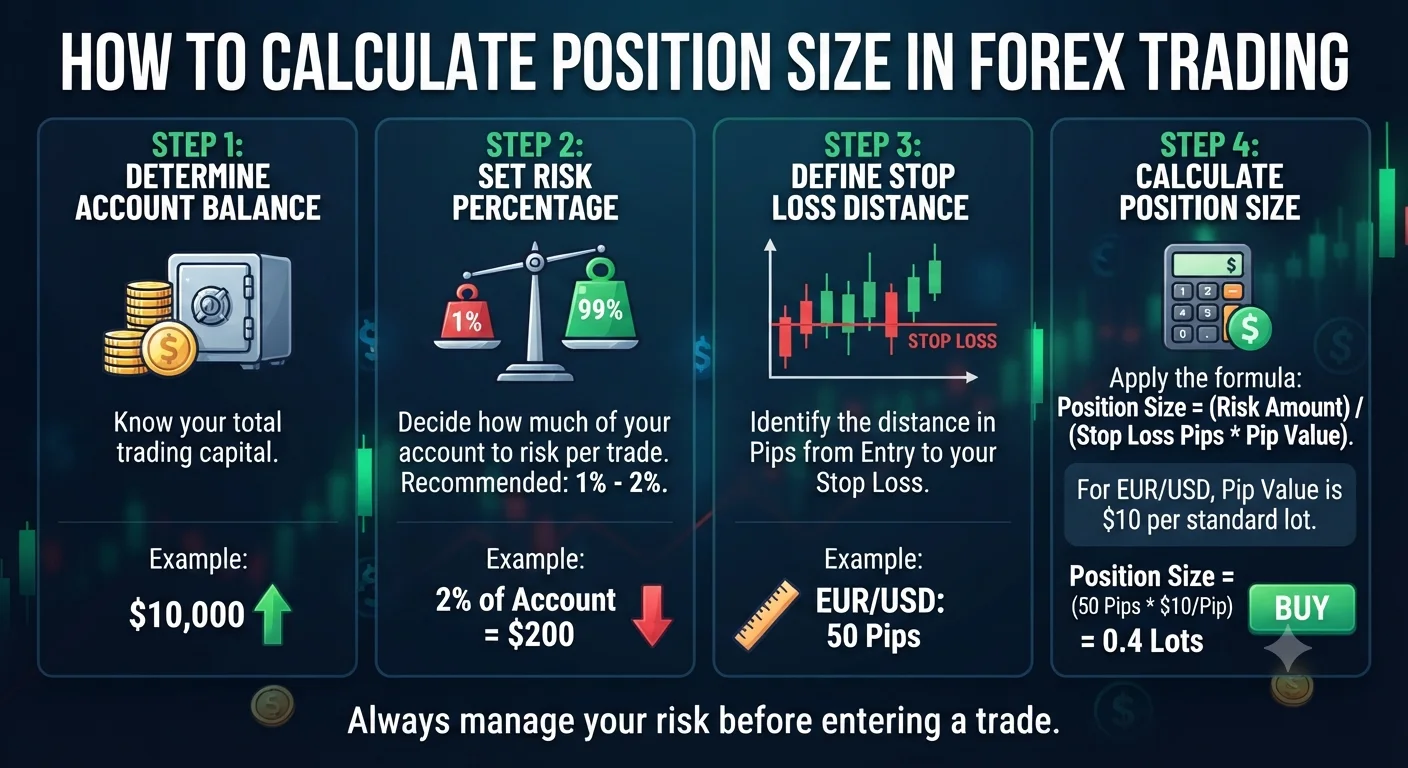
Position sizing is the process of calculating exactly how many units (lots) to trade so that if the trade hits your stop-loss, you lose only a predetermined percentage of your account balance — no more.
The most widely respected rule is the 1% rule: never risk more than 1% of your total account on a single trade.
How to calculate position size:
Formula: Position Size = (Account Balance × Risk %) ÷ (Stop-Loss in Pips × Pip Value)
Example:
- Account balance: $2,000
- Risk per trade: 1% = $20 maximum loss
- Stop-loss distance: 40 pips
- Pip value on a micro lot (1,000 units) of EUR/USD: ~$0.10
$20 ÷ (40 pips × $0.10) = 5 micro lots
This gives you a position size that loses exactly $20 — and no more — if the trade is stopped out. Most trading platforms and brokers provide a position size calculator to make this calculation quick.
Pillar 2 — Stop-Loss Orders
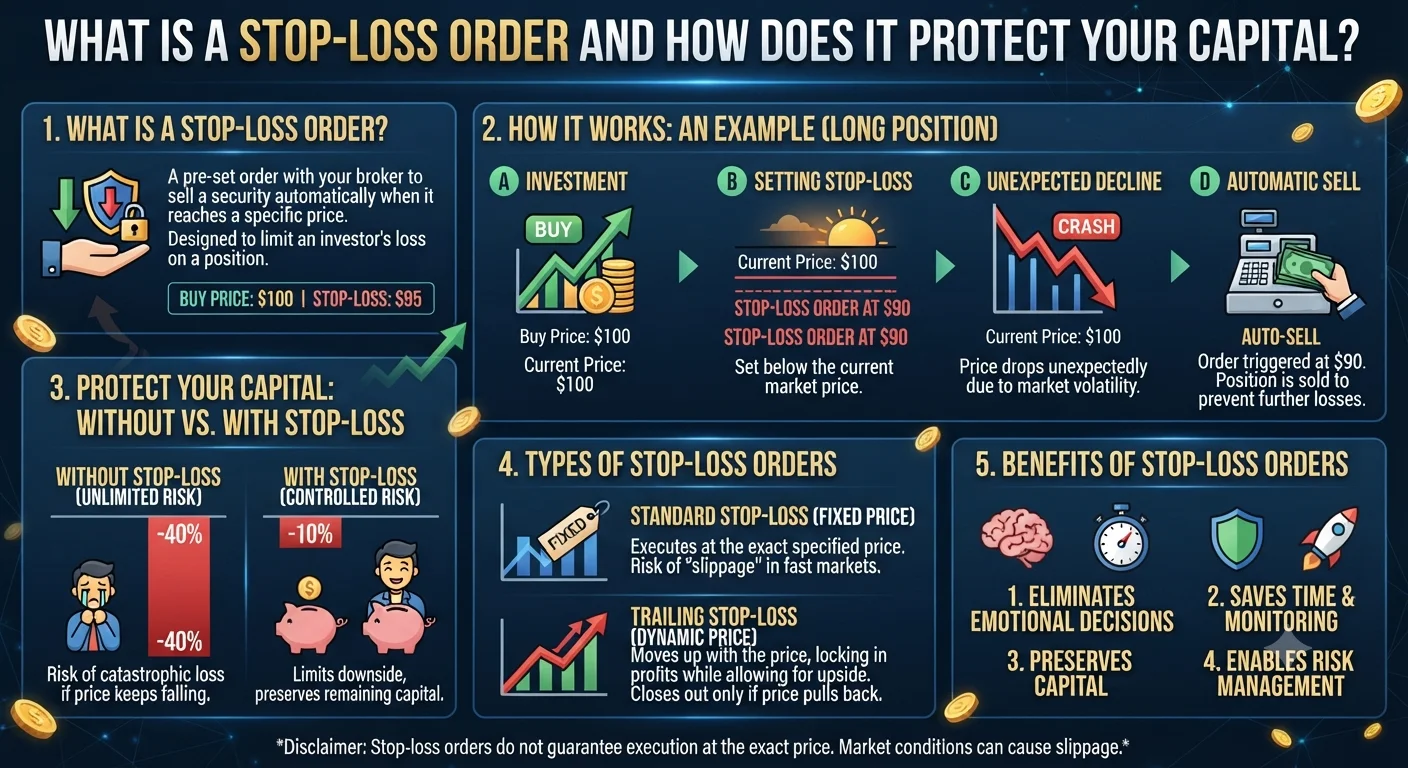
A stop-loss order is an instruction to your broker to automatically close your trade at a specific price if the market moves against you. It is your pre-defined exit point for a losing trade.
Placing a stop-loss before you enter a trade serves two critical functions:
- It defines your risk before the trade opens. You know exactly what you stand to lose — there are no surprises.
- It removes the temptation to hold a losing trade and hope it recovers. Hope is not a trading strategy. A pre-set stop-loss removes the emotional decision entirely.
Where to place a stop-loss:
| Strategy Type | Stop-Loss Placement |
|---|---|
| Buy trade at support | Below the support level |
| Sell trade at resistance | Above the resistance level |
| Breakout trade | Below the breakout level (buys) / above it (sells) |
| Trend-following | Below the most recent swing low (buys) |
| Volatility-based | X × ATR (Average True Range) from entry |
The key principle: your stop-loss should be placed at the level where your trade idea is proven wrong — not at an arbitrary pip distance.
Pillar 3 — Risk-to-Reward Ratio
The risk-to-reward ratio (R:R) compares how much you stand to lose on a trade (the distance to your stop-loss) to how much you stand to gain (the distance to your take-profit target).
A ratio of 1:2 means you risk 1 unit to potentially gain 2 units.
Why this matters so profoundly:
| Win Rate | R:R Ratio | Result Over 100 Trades |
|---|---|---|
| 50% | 1:1 | Break even |
| 40% | 1:2 | Profitable (+40R) |
| 33% | 1:3 | Profitable (+66R) |
| 60% | 1:0.5 | Losing (-20R) |
| 50% | 1:2 | Highly profitable (+50R) |
This table reveals one of the most important — and counterintuitive — truths in trading: you do not need to win the majority of your trades to be profitable, as long as your average winner is larger than your average loser.
Most professional traders target a minimum 1:2 risk-to-reward ratio on every trade. This means that even if only 40% of trades are winners, the strategy produces a profit over a large sample size.
Pillar 4 — Total Account Exposure
Beyond limiting risk on each individual trade, traders must also manage their total open exposure at any given time.
If you have five trades open simultaneously, each risking 1% of your account, your total exposure is 5%. This is generally considered acceptable for a diversified set of uncorrelated trades.
Recommended Articles
 RISK MANAGEMENT TRADING PSYCHOLOGY
 RISK MANAGEMENT TRADING PSYCHOLOGY
Problems arise when:
- Multiple open positions are on correlated pairs (e.g., EUR/USD and GBP/USD both move against you during a USD strength event)
- Total exposure climbs to 10%, 15%, or 20% of the account
- A single market event — a surprise central bank announcement, a geopolitical shock — moves all correlated positions against you at once
Maximum total exposure guideline: Keep simultaneous open risk below 5–6% of total account balance for most strategies.
A Practical Example
A trader has a $5,000 account and applies the 1% rule — a maximum loss of $50 per trade.
They identify a buy setup on USD/JPY:
| Trade Element | Value |
|---|---|
| Entry price | 149.50 |
| Stop-loss | 149.00 (50 pips below entry) |
| Take-profit | 150.50 (100 pips above entry — 1:2 R:R) |
| Risk per trade | $50 (1% of $5,000) |
| Pip value needed | $50 ÷ 50 pips = $1.00 per pip |
| Position size | 1 mini lot (≈$1/pip on USD/JPY) |
Outcome scenario over 20 trades at a 45% win rate:
- 9 winning trades × $100 profit = $900 gain
- 11 losing trades × $50 loss = $550 loss
- Net result: +$350 profit on a $5,000 account (+7%)
And this is achieved with a 45% win rate — losing more trades than winning — purely because the risk-to-reward ratio was set at 1:2.
Why Risk Management Determines Your Trading Results
Regulatory disclosures from major regulated brokers consistently show that 70–80% of retail forex trader accounts lose money. The most common reason is not that retail traders are bad at picking direction — it is that they take losses that are far too large, run out of capital during inevitable drawdown periods, or allow single losing trades to devastate their accounts.
Risk management directly solves each of these problems:
- Survival: It keeps you in the game long enough for your strategy to demonstrate its edge over a statistically meaningful number of trades.
- Psychology: Knowing your exact maximum loss before you enter a trade removes the anxiety and panic that trigger poor decisions during the trade.
- Consistency: Using the same risk percentage on every trade removes emotional variation in trade sizing — one of the most damaging and invisible performance killers.
- Recovery ability: With 1% risk per trade, you could lose 20 consecutive trades and still retain over 80% of your account. With 20% risk per trade, five consecutive losses destroy the account entirely.
Common Risk Management Mistakes
Even traders who understand risk management theory often make these errors in practice:
- Moving the stop-loss further away when a trade moves against them, turning a small planned loss into a catastrophic one.
- Skipping the stop-loss entirely on trades they feel "certain" about — certainty does not exist in markets.
- Increasing position size after losses (revenge trading) in an attempt to recover quickly, which accelerates account destruction.
- Ignoring correlation between open positions — holding EUR/USD, GBP/USD, and AUD/USD simultaneously means all three will likely move against you when the US Dollar strengthens.
- Not accounting for spread and commission in risk calculations — the actual cost per trade includes the spread, which affects both the entry price and the effective stop-loss distance.
Frequently Asked Questions
Q: What is the 1% rule in forex trading?
The 1% rule states that a trader should never risk more than 1% of their total account balance on any single trade. For a $1,000 account, that means a maximum loss of $10 per trade. The rule ensures that even an extended losing streak — which every trader experiences — cannot cause catastrophic damage to the account. Some experienced traders use 0.5% or 2%, depending on their strategy and risk tolerance.
Q: What is a stop-loss order and why is it essential?
A stop-loss order is an automatic instruction to close a trade at a specified price if the market moves against you. It is essential because it defines your risk before you enter the trade, removes emotional decision-making while the trade is live, and prevents small planned losses from becoming large unplanned ones. Every trade should have a stop-loss set at the moment the trade is opened.
Q: What is a good risk-to-reward ratio?
Most professional traders look for a minimum 1:2 risk-to-reward ratio — risking one unit to potentially gain two units. This means that even winning only 40% of trades produces an overall profit. Higher ratios such as 1:3 are preferable but often come with lower win rates, so the two must be balanced appropriately for the specific strategy.
Q: What is a margin call and how do you avoid one?
A margin call occurs when your account losses consume enough of your deposited capital that your broker requires you to either deposit more funds or close positions to prevent further losses. It typically happens when traders use excessive leverage without stop-loss orders. Proper position sizing based on the 1% rule, combined with always using stop-loss orders, effectively prevents margin calls under normal market conditions.
Q: How much money do I need to trade forex with proper risk management?
There is no absolute minimum, but the smaller the account, the harder it is to apply proper position sizing due to minimum lot size constraints. A practical starting point with proper risk management is $500–$1,000, trading micro lots (0.01 lots) with a 1% risk rule. This allows meaningful practice while keeping maximum losses in the range of $5–$10 per trade.